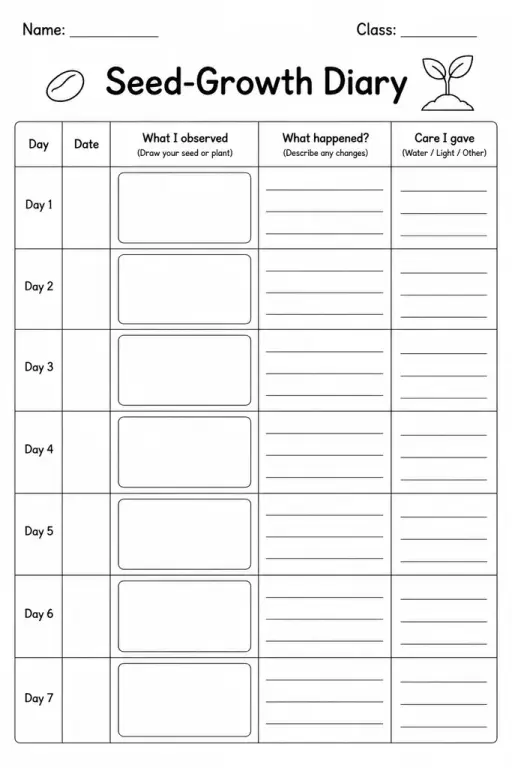
Seed-Growth Diary
Science Templates
Ages 4–11
——
KiwiBee uses optional Google Analytics, Google Ads, and Meta Pixel cookies to understand adult visitors, measure completed sign-ups, and improve campaigns. Essential cookies always stay on. OpenAI’s ChatGPT Ads Pixel also measures page views and completed enquiries after advertising consent, and may use hashed contact details for matching. Privacy policy

The Water-Cycle Diagram (Blank) is an unlabelled landscape illustration of the full hydrological cycle—cloud formations, precipitation, a mountain with runoff, an ocean or lake, underground water flow, and sun rays—with empty label lines and blank arrow paths waiting to be completed by students. Every stage of the cycle is depicted visually but named by nobody, putting the recall work squarely on the learner. Grades 2–6 use this template across Earth science and environmental units to consolidate understanding of evaporation, condensation, precipitation, collection, and transpiration. Teachers project the blank diagram before a lesson to probe prior knowledge, then distribute printed copies for students to annotate during or after instruction. Because the landscape illustration stays constant, teachers can assign the same template at the start and end of a unit to make learning progress tangible and visible.
The illustration shows evaporation, condensation (cloud formation), precipitation, surface runoff, groundwater/infiltration, and collection—the core stages covered in Grades 2–6 curricula.
Yes. A small plant or forest is shown in the landscape, and there is an empty label line near it so Grades 5–6 students can add 'transpiration' as an additional source of atmospheric water vapour.
That is actually its most effective use. Handing out the blank diagram before the lesson surfaces misconceptions early and gives students a personal reason to pay attention during instruction.
The printed version shows faint arrow guides to indicate direction of flow, but students trace or darken them and add labels—this makes the direction of each process an active learning step rather than given information.
See what other teachers think and share a helpful note.
Generate a fresh worksheet for any grade, topic and language. Free.
 Home
Home All solutions
 Pricing
 About us
 KiwiBee for Non-profits
 Events & webinars
 For big organisations
 For schools
 For centers
 For team leaders
 For teachers
 AI and resources
 Resources
 Printable worksheets
 Lesson Packs
 Interactive simulations
 Teacher tools
 AI studio
 Ideas and research