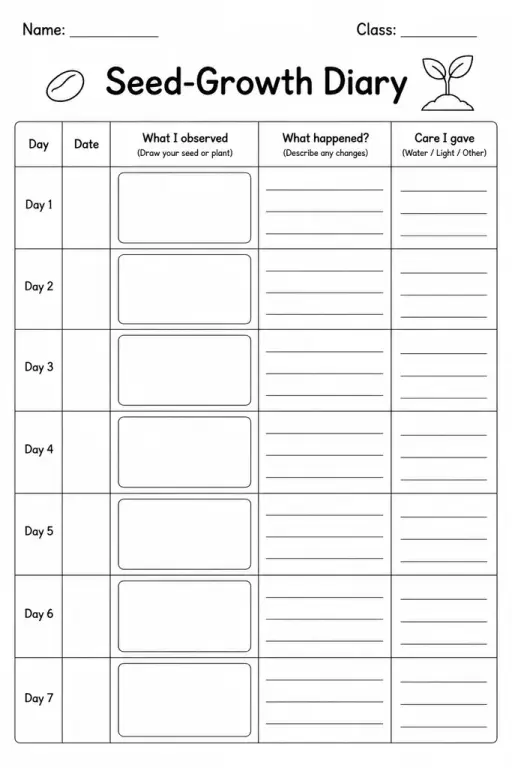
Seed-Growth Diary
Science Templates
Ages 4–11
——
KiwiBee uses optional Google Analytics, Google Ads, and Meta Pixel cookies to understand adult visitors, measure completed sign-ups, and improve campaigns. Essential cookies always stay on. OpenAI’s ChatGPT Ads Pixel also measures page views and completed enquiries after advertising consent, and may use hashed contact details for matching. Privacy policy

The Blank Periodic Table is a fully empty grid that mirrors the standard 18-column layout of the periodic table of elements, complete with numbered boxes for atomic number placement. Students in grades 6–8 use it during chemistry and earth science units to actively fill in element symbols, names, atomic numbers, and masses rather than passively reading a completed chart. Because every cell starts empty, learners must recall or look up each entry themselves, turning a passive reference into an active study exercise. Teachers frequently distribute it as a review tool before tests, as a take-home memorization drill, or as the centrepiece of a "build your own periodic table" project where students colour-code element families and annotate trends such as electronegativity or atomic radius across periods and groups.
Yes — the template includes the standard two-row lanthanide and actinide series displayed below the main grid, matching the full 118-element layout students see in textbooks.
It works best for grades 6–8, when students are first introduced to atomic structure and element properties, but it is equally useful for high-school chemistry review.
Absolutely. Many teachers print it as a blank quiz, asking students to fill in symbols or names for a specific subset of elements rather than the entire table.
Each cell is sized to fit the atomic number, symbol, and element name in small but legible handwriting — similar to the compact cells on a standard classroom periodic table poster.
See what other teachers think and share a helpful note.
Generate a fresh worksheet for any grade, topic and language. Free.
 Home
Home All solutions
 Pricing
 About us
 KiwiBee for Non-profits
 Events & webinars
 For big organisations
 For schools
 For centers
 For team leaders
 For teachers
 AI and resources
 Resources
 Printable worksheets
 Lesson Packs
 Interactive simulations
 Teacher tools
 AI studio
 Ideas and research