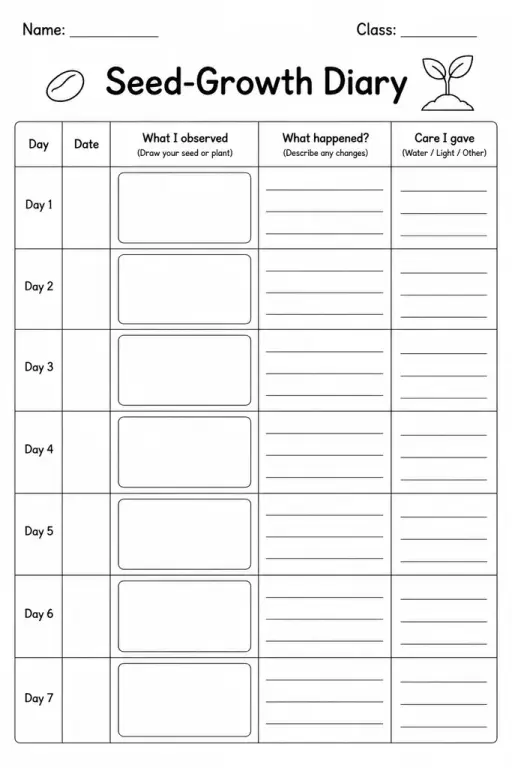
Seed-Growth Diary
Science Templates
Ages 4–11
——
KiwiBee uses optional Google Analytics, Google Ads, and Meta Pixel cookies to understand adult visitors, measure completed sign-ups, and improve campaigns. Essential cookies always stay on. OpenAI’s ChatGPT Ads Pixel also measures page views and completed enquiries after advertising consent, and may use hashed contact details for matching. Privacy policy

This blank cell diagram template provides a clean, unlabelled cross-section illustration suitable for both animal and plant cell studies in grades 5–8. Empty label lines radiate from each organelle, giving students space to write in structures such as the nucleus, mitochondria, cell membrane, endoplasmic reticulum, vacuole, and chloroplasts (plant cell version). Teachers use it at the start of a cell biology unit to activate prior knowledge, mid-unit for guided note-taking, and at the end as a no-prep quiz. Because the diagram ships without any text, it serves as a neutral assessment tool—students can't glean answers from partial labelling. The template is sized to fit a standard lab notebook page, making it practical for science interactive notebooks and binder inserts alike.
KiwiBee offers both versions in the same download. The plant cell includes chloroplasts, a central vacuole, and a rigid cell wall; the animal cell shows centrioles and lacks a cell wall.
Lines point to the nucleus, nucleolus, cell membrane, cytoplasm, mitochondria, Golgi apparatus, endoplasmic reticulum (rough and smooth), ribosomes, lysosomes, vacuole, and—on the plant version—chloroplasts and cell wall.
Yes. Pair it with a word bank printed below the diagram so first-time learners can focus on spatial placement rather than pure recall.
Yes. In your print settings, choose 75–80% scale and it fits neatly on a standard composition-notebook page for interactive notebooks.
See what other teachers think and share a helpful note.
Generate a fresh worksheet for any grade, topic and language. Free.
 Home
Home All solutions
 Pricing
 About us
 KiwiBee for Non-profits
 Events & webinars
 For big organisations
 For schools
 For centers
 For team leaders
 For teachers
 AI and resources
 Resources
 Printable worksheets
 Lesson Packs
 Interactive simulations
 Teacher tools
 AI studio
 Ideas and research