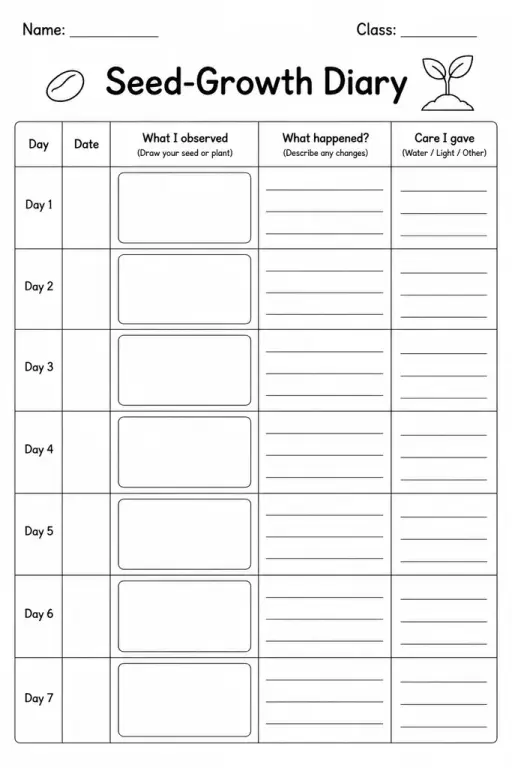
Seed-Growth Diary
Science Templates
Ages 4–11
——
KiwiBee uses optional Google Analytics, Google Ads, and Meta Pixel cookies to understand adult visitors, measure completed sign-ups, and improve campaigns. Essential cookies always stay on. OpenAI’s ChatGPT Ads Pixel also measures page views and completed enquiries after advertising consent, and may use hashed contact details for matching. Privacy policy

The Microscope Drawing Template gives students a pre-drawn circular field-of-view — mimicking the round eyepiece view of a compound microscope — surrounded by structured label lines for magnification level, specimen name, date, and observation notes. Designed for grades 5–8 science labs, it removes the friction of drawing a perfect circle mid-experiment so students can focus entirely on accurate specimen illustration. A second smaller circle in the corner lets students sketch a low-power overview before switching to high power. Teachers use it in biology labs when examining onion cells, pond water, or cheek cells, and it doubles as a formal lab-report insert. Parents supporting home microscopy kits also print multiple copies so children record repeated observations of different specimens on separate sheets without needing graph paper.
The template features one large primary circle for the main high-power drawing and one smaller secondary circle for a low-power overview, giving students a before-and-after comparison on a single sheet.
Yes — the circular field-of-view matches the eyepiece view of compound microscopes, but students can also use it to sketch images displayed on a digital microscope screen.
Students should record the total magnification by multiplying the eyepiece power (usually 10×) by the objective lens power (4×, 10×, 40×, etc.), for example writing '400×' for a 10× eyepiece plus 40× objective.
Yes — the pre-drawn circle and labelled fields scaffold the recording process enough that grade 5 students can complete accurate drawings with minimal prior training in scientific illustration.
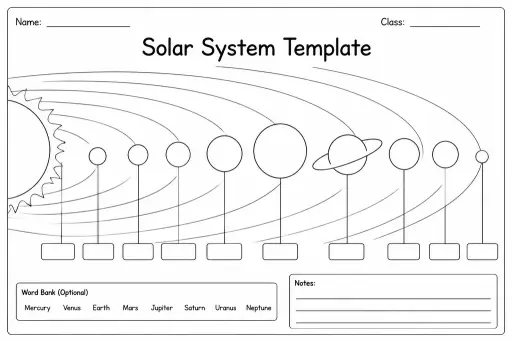
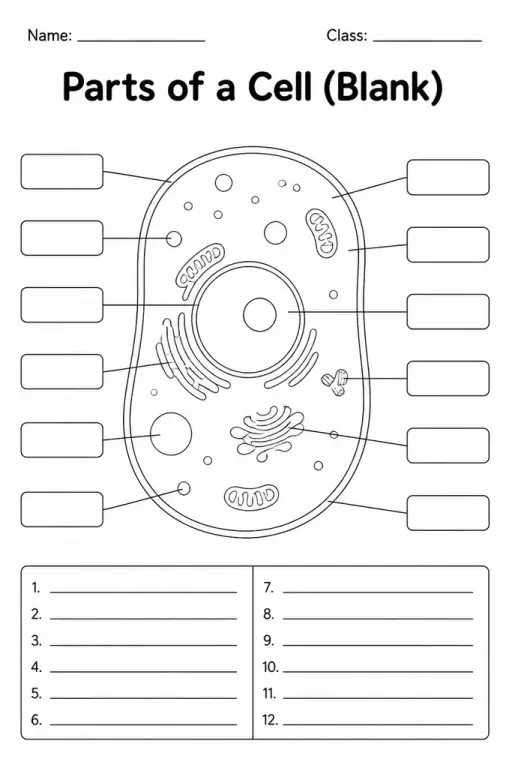
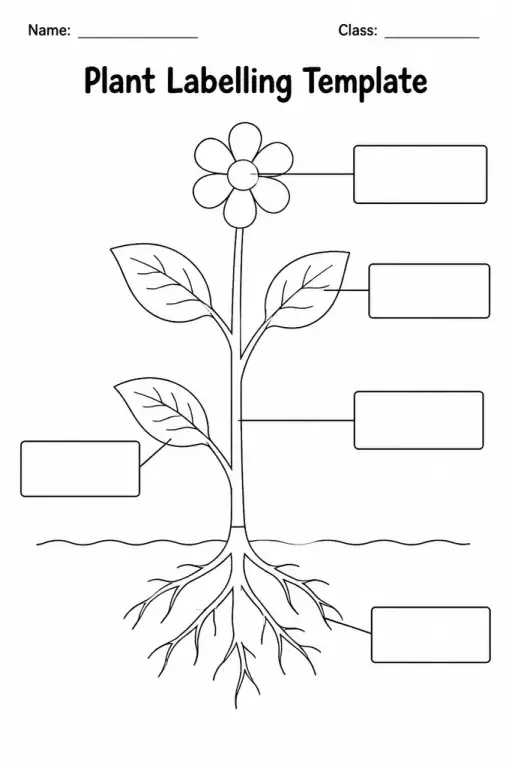
See what other teachers think and share a helpful note.
Generate a fresh worksheet for any grade, topic and language. Free.
 Home
Home All solutions
 Pricing
 About us
 KiwiBee for Non-profits
 Events & webinars
 For big organisations
 For schools
 For centers
 For team leaders
 For teachers
 AI and resources
 Resources
 Printable worksheets
 Lesson Packs
 Interactive simulations
 Teacher tools
 AI studio
 Ideas and research