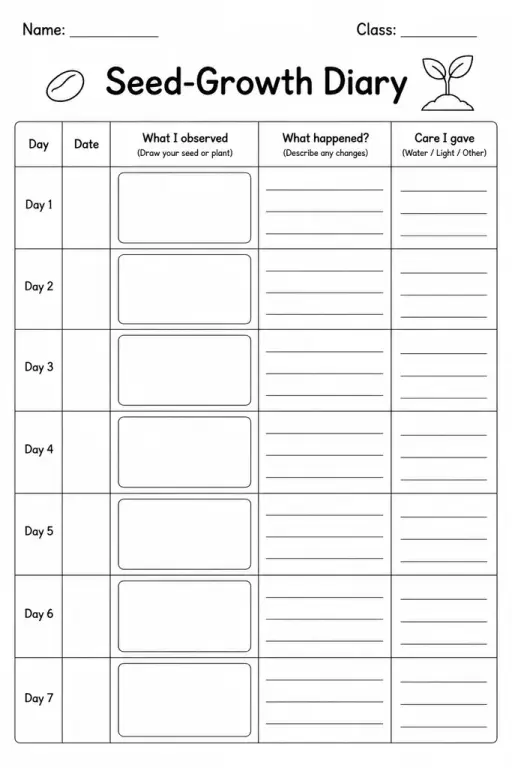
Seed-Growth Diary
Science Templates
Ages 4–11
——
KiwiBee uses optional Google Analytics, Google Ads, and Meta Pixel cookies to understand adult visitors, measure completed sign-ups, and improve campaigns. Essential cookies always stay on. OpenAI’s ChatGPT Ads Pixel also measures page views and completed enquiries after advertising consent, and may use hashed contact details for matching. Privacy policy

The Lab Report Template is a clean, blank scientific writing frame that guides students through every stage of a formal experiment: aim, hypothesis, materials list, method, results (with space for a table or diagram), analysis, and conclusion. Each section is clearly headed but left entirely empty so it adapts to any experiment — from a grade 4 sink-or-float exploration to a grade 8 chemistry titration. The structured layout teaches students the conventions of scientific writing without overwhelming them, and the consistent format makes peer review and teacher marking straightforward. Parents find it useful for science fair projects at home, and teachers value having one universal template that works across all science strands.
The results section provides a blank bordered area with no pre-drawn columns so students can set up a table appropriate to their specific experiment — the number of variables and trials differs every time.
Yes. The Aim/Hypothesis/Method/Results/Conclusion structure is universal across all science disciplines. Teachers simply write subject-specific vocabulary in the section headings or leave guidance on the board.
Absolutely. The clear section labels make it easy for a student (or parent) to work through the report independently. It is especially useful for science fair projects where a structured record is expected by judges.
The Analysis section is where students explain what their results mean and identify patterns or anomalies. The Conclusion is a brief statement about whether the hypothesis was supported and what could be improved next time.
See what other teachers think and share a helpful note.
Generate a fresh worksheet for any grade, topic and language. Free.
 Home
Home All solutions
 Pricing
 About us
 KiwiBee for Non-profits
 Events & webinars
 For big organisations
 For schools
 For centers
 For team leaders
 For teachers
 AI and resources
 Resources
 Printable worksheets
 Lesson Packs
 Interactive simulations
 Teacher tools
 AI studio
 Ideas and research