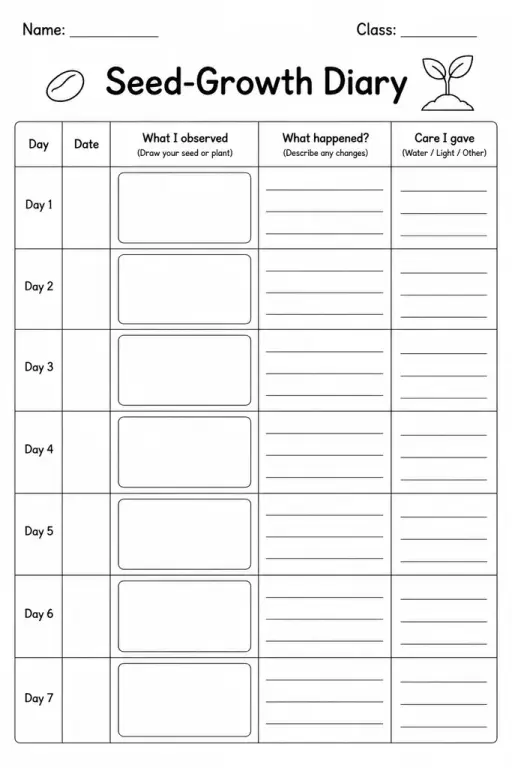
Seed-Growth Diary
Science Templates
Ages 4–11
——
KiwiBee uses optional Google Analytics, Google Ads, and Meta Pixel cookies to understand adult visitors, measure completed sign-ups, and improve campaigns. Essential cookies always stay on. OpenAI’s ChatGPT Ads Pixel also measures page views and completed enquiries after advertising consent, and may use hashed contact details for matching. Privacy policy

The Plant Labelling Template shows a clear line-drawing of a complete flowering plant — roots, stem, leaves, flower, and seed pod — with blank label lines extending from each part, waiting for students to fill in the correct names. Aimed at grades 1–5, it is the go-to printable for introducing plant anatomy without any answers pre-printed, so it works equally well as a teaching scaffold and a no-prep quiz. Teachers use it at the start of a plants unit to assess prior knowledge, mid-unit as guided practice, and again at the end to measure progress with the same sheet. Parents home-schooling through a gardening theme find it a concrete companion to planting seeds or dissecting a flower from the garden. The blank lines can also accept labels in any language, making it useful in bilingual and EAL classrooms.
The illustration includes roots, stem, leaves, flower, and seed pod — the five core parts covered in primary science curricula. All label lines are blank so students supply every name themselves.
Yes. Without a word bank it functions as a closed-response assessment. With a word bank provided separately it becomes a supported matching task — both approaches work with this single printable.
The illustration is a clean, uncluttered line drawing — detailed enough to show each part clearly but simplified to reduce visual noise for young learners. It is not a photo-realistic botanical illustration.
The blank lines accept any language. This makes the template useful in bilingual classrooms or for EAL students who benefit from labelling in their home language alongside English.
See what other teachers think and share a helpful note.
Generate a fresh worksheet for any grade, topic and language. Free.
 Home
Home All solutions
 Pricing
 About us
 KiwiBee for Non-profits
 Events & webinars
 For big organisations
 For schools
 For centers
 For team leaders
 For teachers
 AI and resources
 Resources
 Printable worksheets
 Lesson Packs
 Interactive simulations
 Teacher tools
 AI studio
 Ideas and research