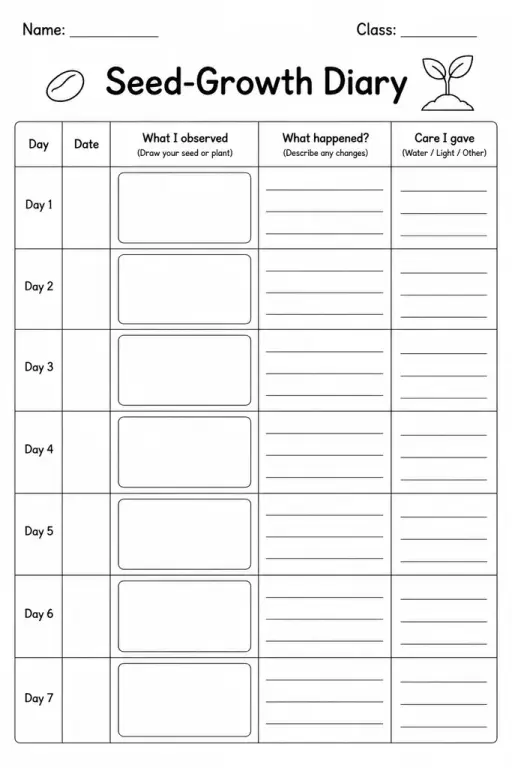
Seed-Growth Diary
Science Templates
Ages 4–11
——
KiwiBee uses optional Google Analytics, Google Ads, and Meta Pixel cookies to understand adult visitors, measure completed sign-ups, and improve campaigns. Essential cookies always stay on. OpenAI’s ChatGPT Ads Pixel also measures page views and completed enquiries after advertising consent, and may use hashed contact details for matching. Privacy policy

This blank solar system template displays eight concentric orbits around a central sun, with a small circle on each orbital path representing each planet—all without names or facts pre-printed. Students in grades 2–7 label each planet in order from the sun, add the planet's name, and can record key facts such as number of moons, surface type, or relative size in the margin boxes provided. Teachers use it during space units to move students beyond passive reading into active mapping of our solar system. The open layout is flexible enough for a quick label-and-go activity in grade 2 and detailed enough to support a comparative planets project in grade 7. Colour-coding each planet according to its surface characteristics adds a visual memory layer that makes the order of planets genuinely stick.
The standard version shows the eight recognised planets. A note at the bottom acknowledges Pluto as a dwarf planet; teachers who wish to include it can ask students to add it as a bonus annotation.
No—true-scale distances would make the inner planets invisible on a letter-sized page. The template uses evenly spaced orbits so all eight planets are clearly visible and labelable.
With a printed word bank or an alphabet-ordered planet list beside the template, grade 2 students can label independently. Without support it suits grades 4 and up.
The template includes small margin annotation boxes next to each planet so students can jot one or two facts (e.g., 'has rings', '2 moons') alongside the label.
See what other teachers think and share a helpful note.
Generate a fresh worksheet for any grade, topic and language. Free.
 Home
Home All solutions
 Pricing
 About us
 KiwiBee for Non-profits
 Events & webinars
 For big organisations
 For schools
 For centers
 For team leaders
 For teachers
 AI and resources
 Resources
 Printable worksheets
 Lesson Packs
 Interactive simulations
 Teacher tools
 AI studio
 Ideas and research