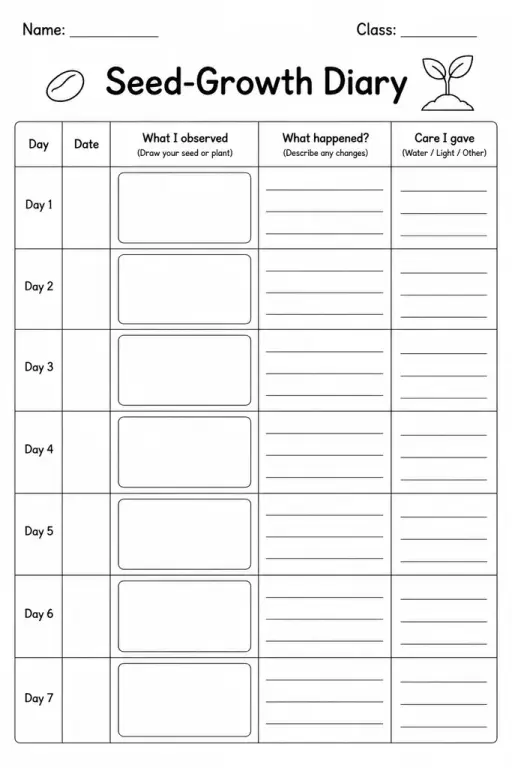
Seed-Growth Diary
Science Templates
Ages 4–11
——
KiwiBee uses optional Google Analytics, Google Ads, and Meta Pixel cookies to understand adult visitors, measure completed sign-ups, and improve campaigns. Essential cookies always stay on. OpenAI’s ChatGPT Ads Pixel also measures page views and completed enquiries after advertising consent, and may use hashed contact details for matching. Privacy policy

The Scientific Method Template is a blank, kid-friendly framework that walks students through each stage of an investigation in sequence: question, hypothesis, materials, procedure, results, and conclusion. Designed for grades 2–6, it gives young scientists a reusable structure so they can focus on thinking rather than formatting. Teachers hand it out before any in-class experiment, and parents find it equally useful for kitchen-table science at home. Because every field is empty, the same single-page template works for a simple sink-or-float test in second grade and a more detailed variables experiment in sixth. Laminate a class set for write-and-wipe reuse, or print fresh copies each time. The predictable layout helps students internalize the scientific process over repeated use until it becomes second nature.
The template is designed for grades 2–6 where students can write independently. For younger learners, consider the Experiment Recording Sheet, which has a simpler two-section layout.
Yes. Laminate the sheet and students can fill it in with a dry-erase marker, wipe it clean, and reuse it across every experiment during the school year.
The results section is intentionally blank so students can choose the format that fits their data — a list, tally, sketch, or simple table — rather than being locked into one style.
The template downloads as a print-ready PDF sized for standard US Letter (8.5 × 11 in) paper, so no resizing is needed before printing.
See what other teachers think and share a helpful note.
Generate a fresh worksheet for any grade, topic and language. Free.
 Home
Home All solutions
 Pricing
 About us
 KiwiBee for Non-profits
 Events & webinars
 For big organisations
 For schools
 For centers
 For team leaders
 For teachers
 AI and resources
 Resources
 Printable worksheets
 Lesson Packs
 Interactive simulations
 Teacher tools
 AI studio
 Ideas and research