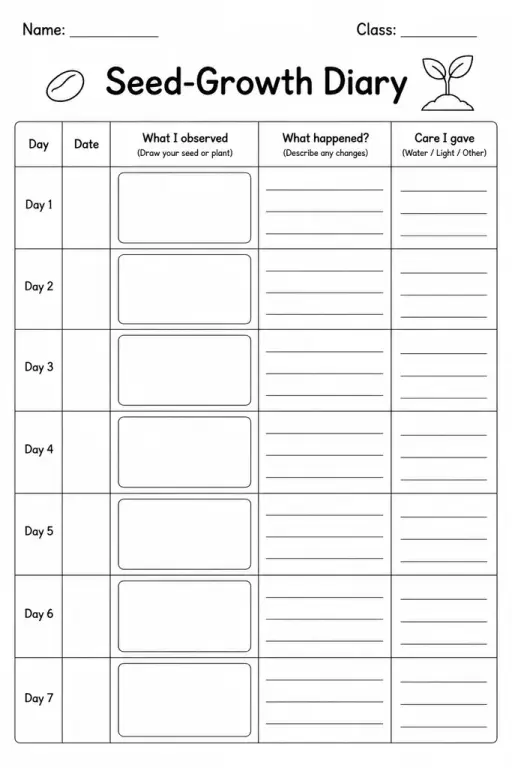
Seed-Growth Diary
Science Templates
Ages 4–11
——
KiwiBee uses optional Google Analytics, Google Ads, and Meta Pixel cookies to understand adult visitors, measure completed sign-ups, and improve campaigns. Essential cookies always stay on. OpenAI’s ChatGPT Ads Pixel also measures page views and completed enquiries after advertising consent, and may use hashed contact details for matching. Privacy policy

The Food Web Template is a blank interconnected diagram—an open grid of empty circles or nodes joined by unlabelled arrows—that students populate with organisms from a chosen ecosystem to show the complex, overlapping relationships between producers, consumers, and decomposers. Unlike a linear food chain, the web format makes visible how removing one species ripples across many others. Designed for Grades 4–8, this template suits mid-unit exploration once students are comfortable with basic food-chain logic and are ready to tackle real ecological complexity. Science teachers use it for ecosystem case studies (coral reef, deciduous forest, Arctic tundra), while environmental studies classes use it to model the impact of invasive species or habitat loss. The blank structure invites genuine thinking rather than mere copying from a textbook diagram.
The food chain template has a single linear path; the food web template has multiple nodes and crossing arrows that represent the real complexity of an ecosystem, making it more suitable for Grades 4–8.
The template ships with 12 empty nodes, which is enough for a thorough ecosystem model at this grade range. Nodes not needed can simply be left blank.
Arrows should point FROM the organism being eaten TO the organism doing the eating—this shows the direction of energy flow and is the standard scientific convention.
Yes. The blank node structure works for any ecosystem—ocean, freshwater, grassland, or arctic—because no organisms are pre-labelled.
See what other teachers think and share a helpful note.
Generate a fresh worksheet for any grade, topic and language. Free.
 Home
Home All solutions
 Pricing
 About us
 KiwiBee for Non-profits
 Events & webinars
 For big organisations
 For schools
 For centers
 For team leaders
 For teachers
 AI and resources
 Resources
 Printable worksheets
 Lesson Packs
 Interactive simulations
 Teacher tools
 AI studio
 Ideas and research