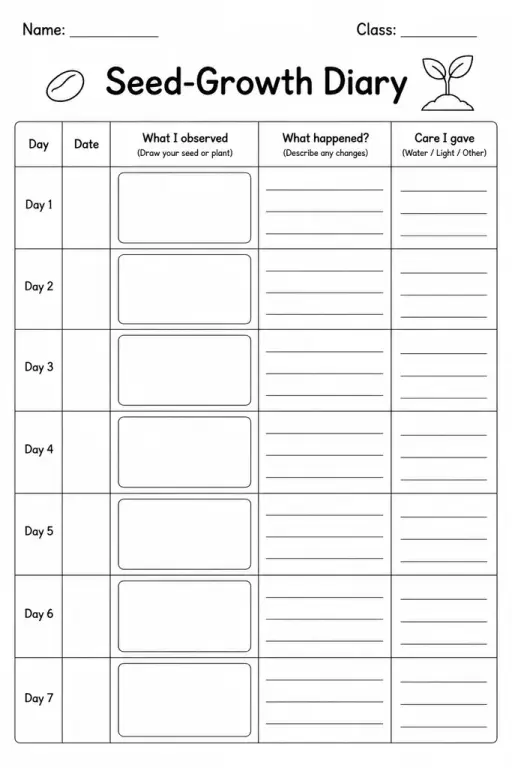
Seed-Growth Diary
Science Templates
Ages 4–11
——
KiwiBee uses optional Google Analytics, Google Ads, and Meta Pixel cookies to understand adult visitors, measure completed sign-ups, and improve campaigns. Essential cookies always stay on. OpenAI’s ChatGPT Ads Pixel also measures page views and completed enquiries after advertising consent, and may use hashed contact details for matching. Privacy policy

This blank rock-cycle diagram template presents the continuous loop of igneous, sedimentary, and metamorphic rock formation without any labels or process arrows pre-filled. Students in grades 4–8 use it to map the journey of rock material through weathering, erosion, deposition, compaction, melting, and cooling—all in one circular visual. Teachers introduce it during Earth science units on geological processes, and students complete it as guided notes, a formative check, or a summative task. The open format encourages deeper processing than reading a labelled textbook diagram: students must recall not just the rock types but the specific processes that connect each stage. The clean layout makes it easy to add colour-coding—one colour per rock type, another for each transformation process—turning the completed diagram into a useful study tool students actually made themselves.
The template includes unlabelled arrows showing the direction of each transformation; students write the process name (e.g., 'melting', 'weathering and erosion') on each arrow and label the rock-type boxes.
Yes, especially when used with a word bank. For grades 4–5, pre-print a list of terms (igneous, sedimentary, metamorphic, melting, cooling, compaction, heat and pressure) so students can focus on placement rather than recall.
The diagram shows three rock types (igneous, sedimentary, metamorphic) and six key processes: weathering/erosion, deposition/compaction, melting, cooling/solidification, heat and pressure, and metamorphism.
Absolutely. Because no labels or answers appear on the template, it works directly as a formative or summative assessment without any modification.
See what other teachers think and share a helpful note.
Generate a fresh worksheet for any grade, topic and language. Free.
 Home
Home All solutions
 Pricing
 About us
 KiwiBee for Non-profits
 Events & webinars
 For big organisations
 For schools
 For centers
 For team leaders
 For teachers
 AI and resources
 Resources
 Printable worksheets
 Lesson Packs
 Interactive simulations
 Teacher tools
 AI studio
 Ideas and research