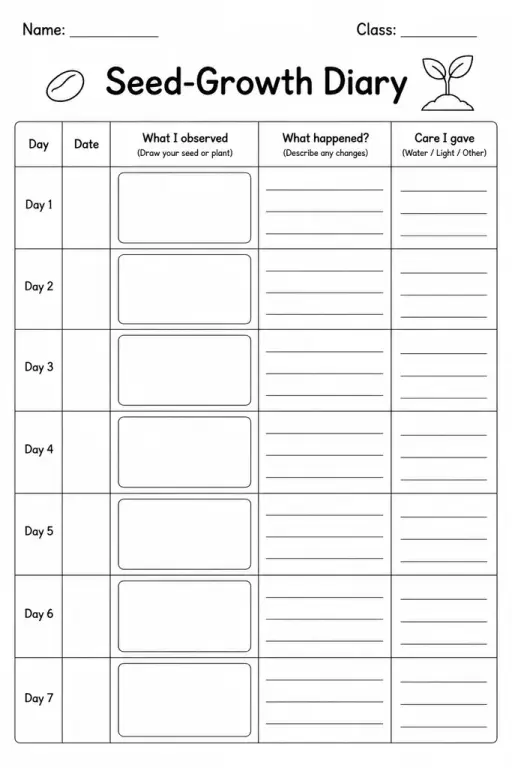
Seed-Growth Diary
Science Templates
Ages 4–11
——
KiwiBee uses optional Google Analytics, Google Ads, and Meta Pixel cookies to understand adult visitors, measure completed sign-ups, and improve campaigns. Essential cookies always stay on. OpenAI’s ChatGPT Ads Pixel also measures page views and completed enquiries after advertising consent, and may use hashed contact details for matching. Privacy policy

The Prediction-Observation-Explanation (POE) template is a three-box science frame that guides students through a complete inquiry cycle. Before any experiment begins, students record what they think will happen; during the activity they note exactly what they observe; afterwards they write a scientific explanation that connects the two. Ideal for grades 3–8, this blank template works equally well at lab benches, during demonstrations, or for home science challenges. Teachers use it to surface prior knowledge and reveal misconceptions, while students develop the disciplined habit of separating prediction from evidence. Because the three boxes are clearly labelled yet left entirely blank, every science concept from states of matter to plant growth to simple machines fits the same reusable sheet.
Yes. The three boxes are intentionally generic so the sheet works for chemistry, biology, physics, and earth science experiments alike.
Encourage specific, measurable language — colours, numbers, durations — rather than vague adjectives. Prompt with 'What did you see, hear, or measure?'
For grades K–2, students can sketch in each box instead of writing. Pair with a teacher scribe or sentence frames to scaffold the language.
A hypothesis worksheet stops at the prediction. The POE adds a dedicated observation column and an explanation step that explicitly closes the reasoning loop.
See what other teachers think and share a helpful note.
Generate a fresh worksheet for any grade, topic and language. Free.
 Home
Home All solutions
 Pricing
 About us
 KiwiBee for Non-profits
 Events & webinars
 For big organisations
 For schools
 For centers
 For team leaders
 For teachers
 AI and resources
 Resources
 Printable worksheets
 Lesson Packs
 Interactive simulations
 Teacher tools
 AI studio
 Ideas and research