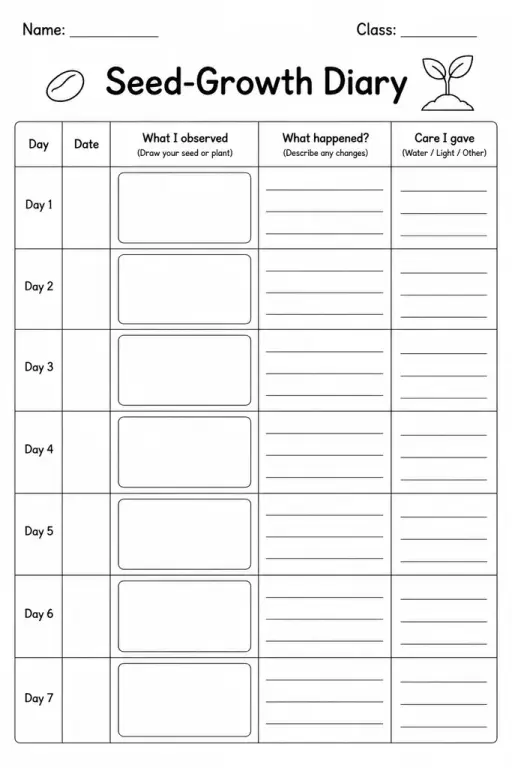
Seed-Growth Diary
Science Templates
Ages 4–11
——
KiwiBee uses optional Google Analytics, Google Ads, and Meta Pixel cookies to understand adult visitors, measure completed sign-ups, and improve campaigns. Essential cookies always stay on. OpenAI’s ChatGPT Ads Pixel also measures page views and completed enquiries after advertising consent, and may use hashed contact details for matching. Privacy policy

The Materials Properties Table is a blank grid template designed for hands-on materials science investigations in grades 1–5. Columns represent testable properties — such as hardness, flexibility, transparency, waterproofing, and magnetic attraction — while rows are left empty for students to write in the materials they are testing. Because both the material names and the property columns are fillable, a single printed sheet supports any materials unit: natural vs manufactured, transparent vs opaque, conductors vs insulators, or whatever your curriculum demands. Teachers appreciate that the open grid encourages students to design their own tests and record results with ticks, crosses, ratings, or short notes rather than circling pre-given answers. The template is equally at home on a classroom workbench, a kitchen table, or as part of a STEM investigation report.
For grade 1, limit to four to five materials and three clear binary properties (is it bendy? is it waterproof? does a magnet stick?). Older students can handle more nuanced ratings.
Pairs work well for most tests — one student tests while the other records — but individual sheets ensure every student has their own data to analyse.
Yes. Remind students that fair testing means using the same amount of force, the same amount of water, or the same magnet distance for every material they test.
The blank grid aligns to materials and properties standards in the Australian Curriculum, UK National Curriculum (Year 1–5 Science), and US NGSS (K–5 physical science), depending on which properties you choose to test.
See what other teachers think and share a helpful note.
Generate a fresh worksheet for any grade, topic and language. Free.
 Home
Home All solutions
 Pricing
 About us
 KiwiBee for Non-profits
 Events & webinars
 For big organisations
 For schools
 For centers
 For team leaders
 For teachers
 AI and resources
 Resources
 Printable worksheets
 Lesson Packs
 Interactive simulations
 Teacher tools
 AI studio
 Ideas and research