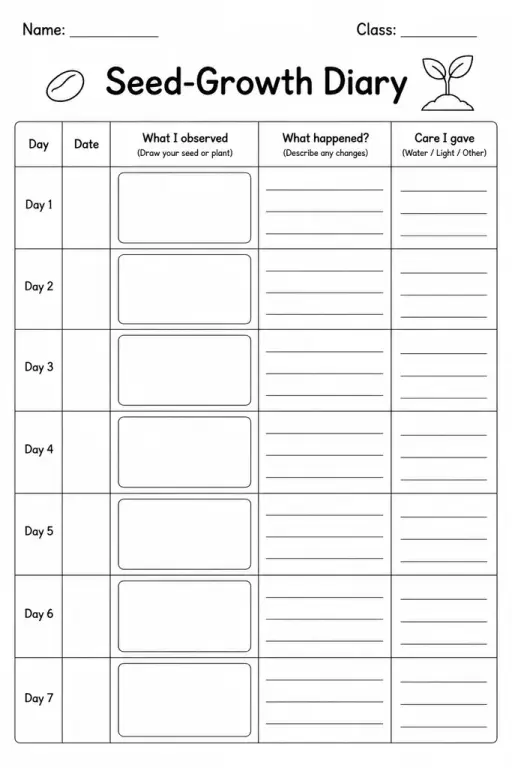
Seed-Growth Diary
Science Templates
Ages 4–11
——
KiwiBee uses optional Google Analytics, Google Ads, and Meta Pixel cookies to understand adult visitors, measure completed sign-ups, and improve campaigns. Essential cookies always stay on. OpenAI’s ChatGPT Ads Pixel also measures page views and completed enquiries after advertising consent, and may use hashed contact details for matching. Privacy policy

The Life-Cycle Diagram (Blank) is an empty circular template for grades 1–6 with four evenly spaced arrow-linked stages arranged in a loop, ready for students to fill in any organism's life cycle from scratch. Because nothing is pre-labelled, the same printable works for a butterfly, a frog, a bean plant, a chicken, or any other creature the class is studying. Students sketch each stage inside the provided circle segment and write the stage name below it, making the template equally accessible to early writers and more advanced students. Teachers appreciate that one template covers an entire year of life-science units without buying topic-specific versions. Home-school parents find it a neat way to supplement a nature documentary or a garden-to-table growing project with a structured visual summary.
The four-stage layout covers the most common school life cycles (butterfly: egg, larva, pupa, adult). For organisms with three stages, leave one segment lightly shaded. For organisms with more stages, students can subdivide a segment or add a note — the open design accommodates both.
Yes. It works for seed, germination, seedling, and mature plant cycles, or any other plant reproductive cycle the class is exploring.
This template has four stages, which matches the majority of primary-school life-cycle topics. For organisms requiring more stages, pair it with your own addition or use the Observation Drawing Template to sketch an extended sequence.
Print the blank template and ask students to complete it from memory at the end of a unit. Alternatively, provide a word bank of stage names and ask students to place them correctly and draw each stage.
See what other teachers think and share a helpful note.
Generate a fresh worksheet for any grade, topic and language. Free.
 Home
Home All solutions
 Pricing
 About us
 KiwiBee for Non-profits
 Events & webinars
 For big organisations
 For schools
 For centers
 For team leaders
 For teachers
 AI and resources
 Resources
 Printable worksheets
 Lesson Packs
 Interactive simulations
 Teacher tools
 AI studio
 Ideas and research