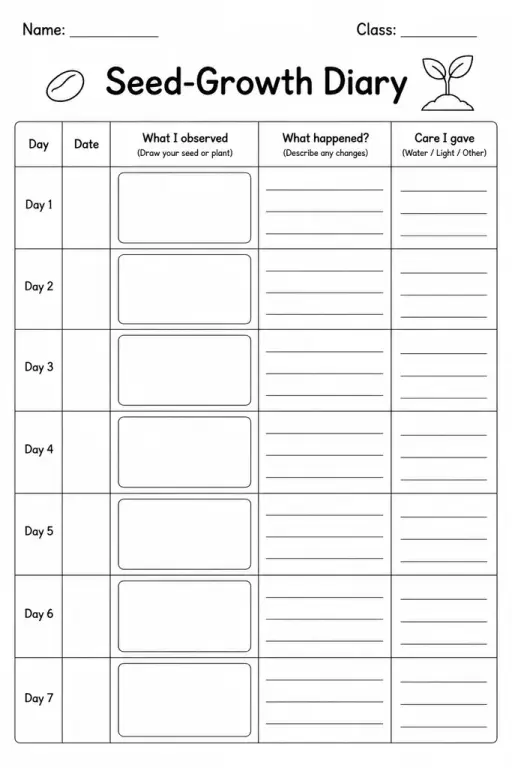
Seed-Growth Diary
Science Templates
Ages 4–11
——
KiwiBee uses optional Google Analytics, Google Ads, and Meta Pixel cookies to understand adult visitors, measure completed sign-ups, and improve campaigns. Essential cookies always stay on. OpenAI’s ChatGPT Ads Pixel also measures page views and completed enquiries after advertising consent, and may use hashed contact details for matching. Privacy policy

The Food Chain Template is a blank linear arrow diagram—typically four to five linked boxes connected by directional arrows—that students fill in to show the flow of energy from producer to apex predator. Nothing is pre-printed in the boxes, so the same page works for a grassland chain, an ocean chain, or a rainforest chain depending on the current unit. Grades 2–6 students use it as a note-taking frame during lessons, a revision tool before tests, or a creative task where they research and build their own chains from scratch. Teachers like that the arrow structure keeps the direction of energy transfer visible at a glance, preventing the common misconception that arrows mean 'eats'. A single printed copy can serve multiple purposes when laminated for dry-erase use across different ecosystems throughout the year.
The standard version has five boxes connected by four arrows, which is enough for most Grade 2–6 chains. You can skip a box if your chain only has four steps.
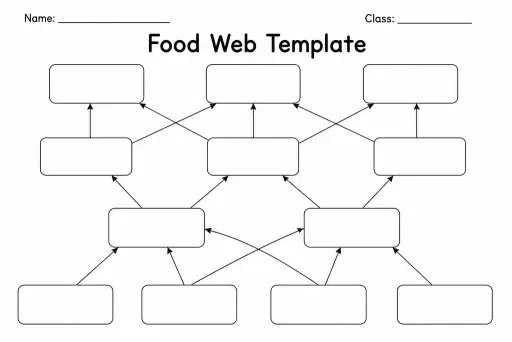
A food chain shows one single linear path of energy transfer; a food web template shows multiple overlapping chains in the same ecosystem, which is a more advanced concept suited to Grades 4–8.
Most primary science curricula start with the plant (producer) as the first box. If your curriculum includes the sun as an energy source, simply add a small sun icon before the first box.
Yes. It is a great tool for a garden or park walk—identify plants, insects, birds, and mammals spotted on the outing and build a local food chain together.
See what other teachers think and share a helpful note.
Generate a fresh worksheet for any grade, topic and language. Free.
 Home
Home All solutions
 Pricing
 About us
 KiwiBee for Non-profits
 Events & webinars
 For big organisations
 For schools
 For centers
 For team leaders
 For teachers
 AI and resources
 Resources
 Printable worksheets
 Lesson Packs
 Interactive simulations
 Teacher tools
 AI studio
 Ideas and research