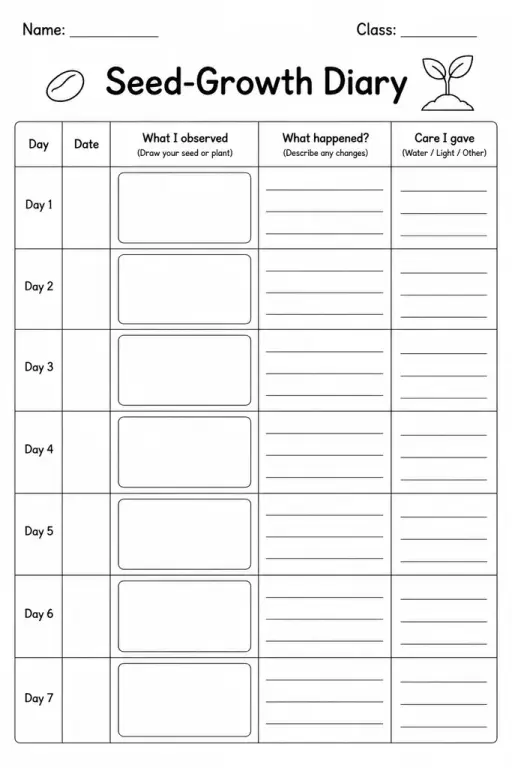
Seed-Growth Diary
Science Templates
Ages 4–11
——
KiwiBee uses optional Google Analytics, Google Ads, and Meta Pixel cookies to understand adult visitors, measure completed sign-ups, and improve campaigns. Essential cookies always stay on. OpenAI’s ChatGPT Ads Pixel also measures page views and completed enquiries after advertising consent, and may use hashed contact details for matching. Privacy policy

The Dichotomous Key Template is a blank, branching flowchart designed for students to build their own yes/no identification keys for organisms, minerals, leaves, or any group of objects. Each fork in the tree presents two opposing characteristics — users follow the correct branch until they reach a final identification. Grades 5–8 use it across biology, botany, and earth-science units when learning scientific classification. Rather than reading a pre-filled key, students construct one from scratch after observing a set of specimens, forcing them to notice distinguishing features and articulate them as precise binary questions. Teachers assign it as a culminating lab activity after a collection walk, a seed-sorting exercise, or a rock-and-mineral identification unit. The blank format means the same printable works for any subject where objects must be systematically sorted.
The template provides enough pre-drawn branch nodes to classify up to eight distinct items across four levels of branching — sufficient for most classroom specimen sets.
Yes — the PDF is designed so students can extend branches by hand onto a second printed sheet, or the teacher can duplicate and tape sheets together for larger classification tasks.
Each question should present exactly two mutually exclusive options based on a single, observable physical characteristic (e.g. 'Does the leaf have a smooth edge?' yes/no), with no room for a maybe answer.
Absolutely — it works for any classification task, including sorting geometric shapes in math, distinguishing historical periods in social studies, or organising vocabulary words in language arts.
See what other teachers think and share a helpful note.
Generate a fresh worksheet for any grade, topic and language. Free.
 Home
Home All solutions
 Pricing
 About us
 KiwiBee for Non-profits
 Events & webinars
 For big organisations
 For schools
 For centers
 For team leaders
 For teachers
 AI and resources
 Resources
 Printable worksheets
 Lesson Packs
 Interactive simulations
 Teacher tools
 AI studio
 Ideas and research