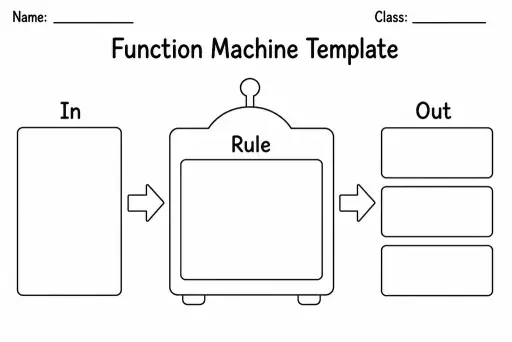
Function Machine Template
Math Templates
Ages 4–11
——
KiwiBee uses optional Google Analytics, Google Ads, and Meta Pixel cookies to understand adult visitors, measure completed sign-ups, and improve campaigns. Essential cookies always stay on. OpenAI’s ChatGPT Ads Pixel also measures page views and completed enquiries after advertising consent, and may use hashed contact details for matching. Privacy policy

The Twenty Frame is a blank grid of twenty boxes arranged in four rows of five, extending the familiar ten-frame structure to cover numbers up to 20. Where the double ten frame stacks two separate grids, the twenty frame presents all twenty cells as a single unified field — a subtle but important visual difference that helps students see the full range of 1–20 without a dividing line in the middle. Kindergarten and grades 1–2 teachers use it for number-line anchoring, skip-counting, and exploring even and odd patterns across the full range. Students working on addition and subtraction bridging through 10 benefit from the continuous layout because they can trace the "jump" from row to row without switching frames. It is also popular for classroom games that require tracking scores or tallies up to 20 within a single structured mat.
The twenty frame is a single unbroken 4×5 grid, while the double ten frame shows two distinct 2×5 grids. The continuous layout makes skip-counting and even/odd patterns easier to see across the whole range.
Kindergarten through grade 2 is the primary range. Kindergartners use it for numbers 11–20; first and second graders extend it to addition, subtraction, and skip-counting explorations.
Yes — students can draw dots, color boxes, or write a number in each cell. A pencil-only approach works well in independent practice or during timed fact-fluency drills.
It aligns with CCSS.MATH.CONTENT.K.CC, K.OA, 1.NBT, and 2.OA standards covering counting to 20, operations within 20, and understanding place value in teen numbers.
See what other teachers think and share a helpful note.
Generate a fresh worksheet for any grade, topic and language. Free.
 Home
Home All solutions
 Pricing
 About us
 KiwiBee for Non-profits
 Events & webinars
 For big organisations
 For schools
 For centers
 For team leaders
 For teachers
 AI and resources
 Resources
 Printable worksheets
 Lesson Packs
 Interactive simulations
 Teacher tools
 AI studio
 Ideas and research