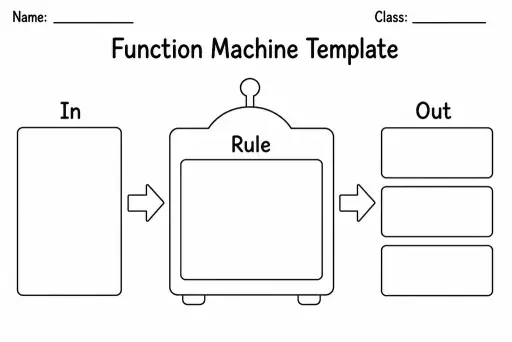
Function Machine Template
Math Templates
Ages 4–11
——
KiwiBee uses optional Google Analytics, Google Ads, and Meta Pixel cookies to understand adult visitors, measure completed sign-ups, and improve campaigns. Essential cookies always stay on. OpenAI’s ChatGPT Ads Pixel also measures page views and completed enquiries after advertising consent, and may use hashed contact details for matching. Privacy policy

The Five Frame is a single row of five blank boxes — the smallest and simplest structured number mat available for early learners. Designed for PreK and kindergarten students who are just beginning to count, it limits the working range to 0–5 so young children are never overwhelmed. The narrow frame lets a child see at a glance whether a row is empty, partly filled, or completely full, which builds the five-anchor that underpins all future number-sense work. Preschool teachers use the five frame during circle time to count attendance, weather items, or objects from a seasonal bin. Kindergarten teachers bring it in before introducing the ten frame so students already understand filling and comparing before the numbers grow. Parents and caregivers find it approachable for short counting games at home, requiring nothing more than small objects — coins, buttons, or cereal — as counters.
Young children in PreK or early kindergarten are still securing one-to-one correspondence and cardinality within 5. The smaller frame removes visual noise and lets them build confidence before the range doubles.
Yes — use two colors of counters to represent each addend. For example, 2 red and 3 yellow fills the frame, making it concrete that 2 + 3 = 5.
Use the print-to-fit or custom-scale option to reduce it to about 60–70% of full page, then cut and glue it into the journal. A 4-up print setting also works well.
The five frame is central to Math Their Way, Everyday Mathematics, and Singapore-influenced curricula at the PreK–K level, as well as being a key component in Number Talks routines.
See what other teachers think and share a helpful note.
Generate a fresh worksheet for any grade, topic and language. Free.
 Home
Home All solutions
 Pricing
 About us
 KiwiBee for Non-profits
 Events & webinars
 For big organisations
 For schools
 For centers
 For team leaders
 For teachers
 AI and resources
 Resources
 Printable worksheets
 Lesson Packs
 Interactive simulations
 Teacher tools
 AI studio
 Ideas and research