Printable template
Times-Table Practice Template
Blank columns for one table.
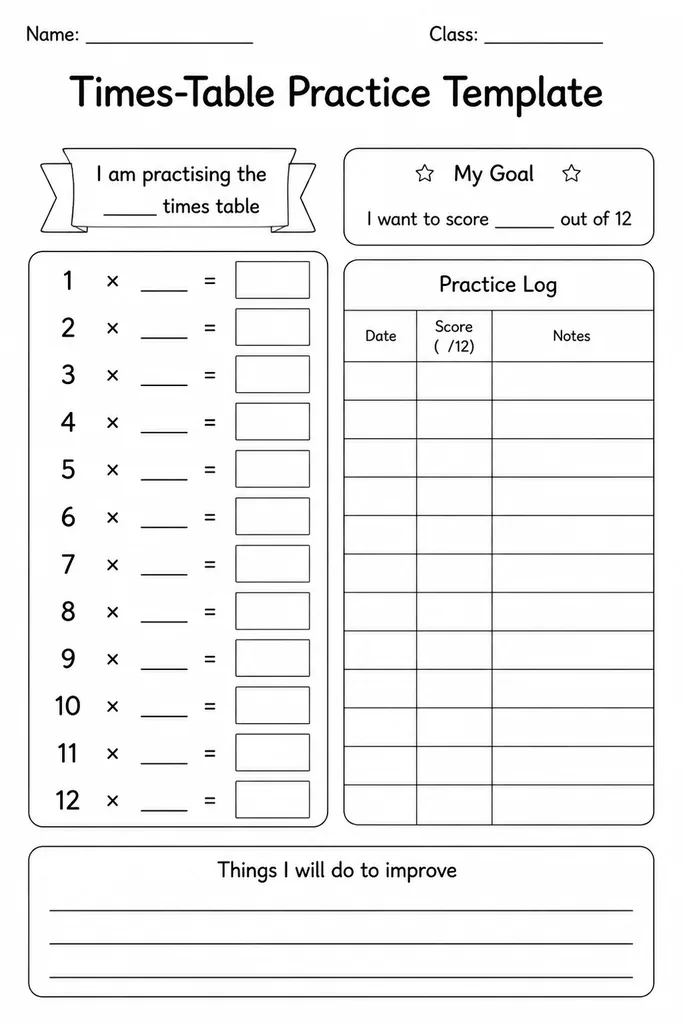
The times-table practice template focuses on a single multiplication table at a time, providing a set of blank columns where students write the factor, the multiplier, and the product for every fact in that one table. By isolating one table per sheet—rather than presenting all tables at once—the template removes cognitive overload and lets students drill deeply on a specific set before moving on. Grades 2–5 students use it to master one table per week, building cumulative fluency fact by fact. Teachers find the single-table format ideal for homework assignments, early-finisher activities, and short daily warm-ups. A student who is solid on 2s, 5s, and 10s but shaky on 7s can receive targeted 7s sheets while classmates work on their own weak spots. Parents appreciate the narrow focus too: ten minutes on the 6s table is a manageable, achievable session rather than an overwhelming whole-chart review.
Learning objectives
- Memorise all facts within a single multiplication table through repetitive writing practice
- Recognise the relationship between multiplication and repeated addition for one table
- Build automaticity on targeted facts before moving to the next table
- Self-identify which tables need additional practice through timed completion checks
- Connect one specific table to its matching division facts
- Develop number fluency and confidence for standardised assessments
How to use this template
- Choose the specific table to practise (e.g., the 7s) and write it as a heading at the top of the template.
- Fill the first column with the multiplier sequence (1 through 12) and the second column with the constant factor (e.g., 7 repeated).
- Work through the product column from top to bottom, writing each answer from memory and skipping any unknown facts to return to later.
- Set a timer for two minutes to build speed on a table the student already knows, aiming to lower the completion time across daily attempts.
- After finishing, check answers against a reference chart, circle any errors, and write the correct product three times to reinforce it.
Classroom & home ideas
- Table of the week routine: assign a different table each Monday; students complete one timed sheet daily and compare their Monday-versus-Friday times as a visible fluency goal.
- Peer quiz pairs: one student covers the product column on their completed sheet while a partner reads out the facts aloud; partners swap roles after ten questions.
- Skip-counting prerequisite: before writing products, students count aloud by the target number down the page, then fill the products using the oral pattern as a scaffold.
- Fact-family extension: after completing the multiplication column, students flip the template over and write the two matching division sentences for each row, showing the inverse relationship.
- Mastery certificate system: post a chart of all 12 tables; students earn a sticker on each table once they complete a timed sheet with 100% accuracy, motivating systematic progression.
Skills practised
Frequently asked questions
In what order should students work through the tables?
A common sequence starts with 2s, 10s, 5s, and 11s (easy patterns), then 3s, 4s, 6s, 9s (moderate), and finally 7s, 8s, and 12s (typically hardest). Adjust based on individual student progress.
How long should a single practice session last?
Short, frequent sessions work better than long blocks. Aim for 5–10 minutes daily per table. Daily practice across a week typically yields solid recall; scattered long sessions do not.
What if a student already knows all 12 tables?
Use the template for speed work—set a 60-second target and challenge the student to write all 12 facts of a given table under the clock. Or use it for out-of-order 'random order' practice.
Can this template be used for division practice too?
Yes. Re-label the columns as 'dividend ÷ divisor = quotient' and fill the dividend and divisor columns while leaving the quotient blank. The single-table focus works equally well for division.
Likes & comments
See what other teachers think and share a helpful note.
Create more worksheets in our Worksheet Studio
Generate fresh worksheets for any grade, topic, and language — free.
Open the Worksheet StudioRelated worksheets
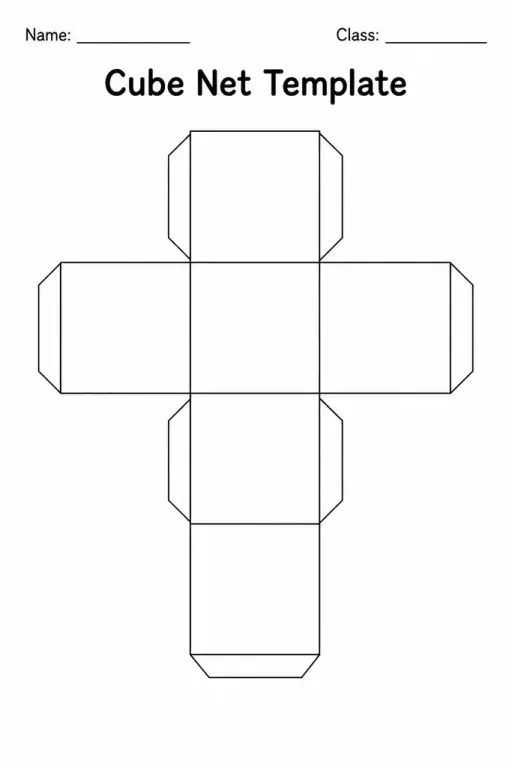
Cube Net Template
Triangular / Tessellation Grid
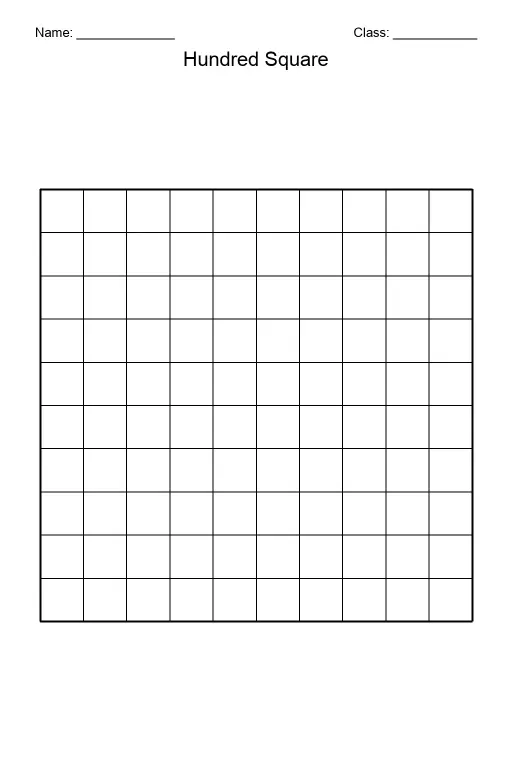
Hundred Square (Blank)
Maths Journal Page
Twenty Frame
Column Addition Grid
Squared Maths Paper
 For big organisations
 For schools
 For centers
 For team leaders
 For teachers
 AI and resources
 Printable worksheets
 Interactive simulations
 Teacher tools
 AI studio
 Ideas and research