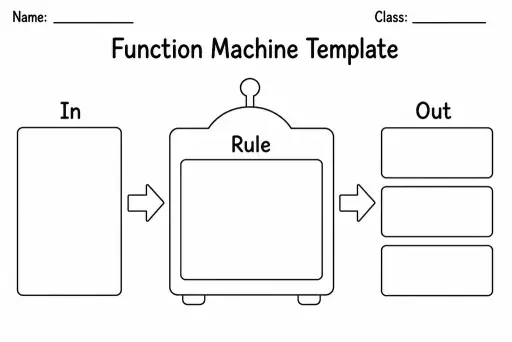
Function Machine Template
Math Templates
Ages 4–11
——
KiwiBee uses optional Google Analytics, Google Ads, and Meta Pixel cookies to understand adult visitors, measure completed sign-ups, and improve campaigns. Essential cookies always stay on. OpenAI’s ChatGPT Ads Pixel also measures page views and completed enquiries after advertising consent, and may use hashed contact details for matching. Privacy policy

The Probability Scale (Blank) template features a clean horizontal number line running from 0 (impossible) to 1 (certain), with equally spaced tick marks and blank label boxes above and below the line. Students write or draw events in the boxes and then place arrows or labels at the correct position to show how likely each event is. Ideal for grades 4–8, it works for introducing probability vocabulary (impossible, unlikely, even chance, likely, certain) as well as for deeper work with fractions, decimals, and percentages as probability values. Teachers appreciate that the completely blank scale can be used with any set of events — weather, spinners, dice, real-life scenarios — without reprinting different versions.
The scale is fully blank — no labels, fractions, or events are printed. This lets teachers customise it for any lesson, from a simple vocabulary introduction to a fraction-based probability unit.
Yes. The unlabelled tick marks work equally well for placing fractions (0, 1/4, 1/2, 3/4, 1) or percentages (0%, 25%, 50%, 75%, 100%), making it adaptable across the full grades 4–8 range.
The scale accommodates six to eight labelled events comfortably when students write above and below the line alternately. For larger sets, print two copies or use the laminated version with coloured markers.
Absolutely. Starting with the blank scale and vocabulary labels (impossible → certain) is a well-established entry point for grade 4–5 students encountering probability for the first time.
See what other teachers think and share a helpful note.
Generate a fresh worksheet for any grade, topic and language. Free.
 Home
Home All solutions
 Pricing
 About us
 KiwiBee for Non-profits
 Events & webinars
 For big organisations
 For schools
 For centers
 For team leaders
 For teachers
 AI and resources
 Resources
 Printable worksheets
 Lesson Packs
 Interactive simulations
 Teacher tools
 AI studio
 Ideas and research