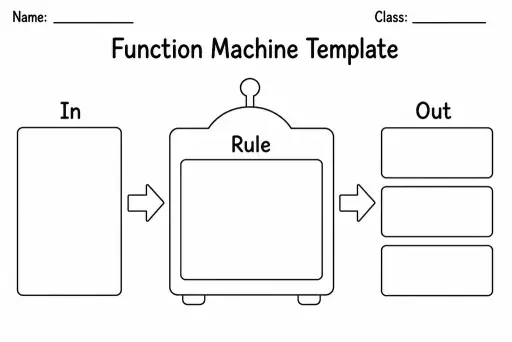
Function Machine Template
Math Templates
Ages 4–11
——
KiwiBee uses optional Google Analytics, Google Ads, and Meta Pixel cookies to understand adult visitors, measure completed sign-ups, and improve campaigns. Essential cookies always stay on. OpenAI’s ChatGPT Ads Pixel also measures page views and completed enquiries after advertising consent, and may use hashed contact details for matching. Privacy policy

Squared Maths Paper is the familiar small-square exercise page found in European and Australian maths notebooks — a full sheet of neat, evenly spaced grid lines that keeps workings aligned, numbers in columns, and geometric sketches proportional. Students across grades 1–8 use it for everything from long multiplication and division layouts to drawing angles, plotting simple functions, and organising algebra steps. Because the template is completely blank with no headings or axes printed on it, every student can orient it however the task demands — portrait for column arithmetic, landscape for wide data tables. Teachers appreciate the clean slate for assessments, class exercises, and timed drills. Parents print it at home when standard lined paper makes maths look messy and hard to follow.
The classic squared maths paper uses 5 mm squares — the standard size for school maths notebooks in most European and Australian curricula.
The terms are often used interchangeably, but 'squared maths paper' typically refers to the exercise-book style used for written working-out, while 'graph paper' is associated more with plotting charts and graphs.
Early primary students can use it, though they may find 5 mm squares tight. For grades K–3, consider the 2 cm graph paper on this site for more comfortable writing space.
Yes — squared paper is standard in both curricula and is explicitly recommended for multi-digit written calculations and geometry work at primary and lower secondary level.
See what other teachers think and share a helpful note.
Generate a fresh worksheet for any grade, topic and language. Free.
 Home
Home All solutions
 Pricing
 About us
 KiwiBee for Non-profits
 Events & webinars
 For big organisations
 For schools
 For centers
 For team leaders
 For teachers
 AI and resources
 Resources
 Printable worksheets
 Lesson Packs
 Interactive simulations
 Teacher tools
 AI studio
 Ideas and research