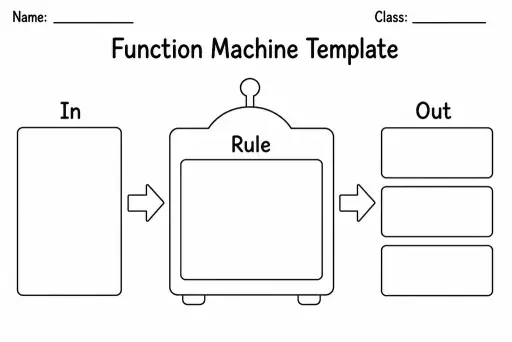
Function Machine Template
Math Templates
Ages 4–11
——
KiwiBee uses optional Google Analytics, Google Ads, and Meta Pixel cookies to understand adult visitors, measure completed sign-ups, and improve campaigns. Essential cookies always stay on. OpenAI’s ChatGPT Ads Pixel also measures page views and completed enquiries after advertising consent, and may use hashed contact details for matching. Privacy policy

A cube net template is a flat, foldable printable showing the six square faces of a cube laid out in a cross or T-shape pattern. Students in grades 2–6 use it to explore 3-D geometry by cutting, folding, and taping the net into a real cube — no pre-drawn labels or numbers, just clean squares ready for any lesson. Teachers introduce cube nets when studying geometric solids, surface area, or spatial reasoning. The blank faces invite students to label vertices, colour faces, calculate surface area, or create a number-cube for probability games. Because it prints on a single sheet and requires only scissors and tape, it works equally well as a desk activity, take-home project, or maths-centre task.
Printed at 100% on A4 or US letter, each square face measures roughly 5 cm (2 in), making a compact, desk-friendly cube. Scale the print percentage up or down to get larger or smaller cubes.
Most grade-2 students can fold with guidance; cutting is easier with blunt craft scissors. Pre-scoring the fold lines with a ruler and an empty ballpoint pen makes folding crisper and reduces frustration.
There are 11 distinct cube nets. This template shows the most common cross layout, which is the easiest for students to visualise. After completing it, older students can try sketching alternative valid nets as an extension activity.
80–90 gsm copy paper works fine for one-use models. For a sturdier cube students will handle repeatedly — as a die or display piece — print on 160–200 gsm cardstock.
See what other teachers think and share a helpful note.
Generate a fresh worksheet for any grade, topic and language. Free.
 Home
Home All solutions
 Pricing
 About us
 KiwiBee for Non-profits
 Events & webinars
 For big organisations
 For schools
 For centers
 For team leaders
 For teachers
 AI and resources
 Resources
 Printable worksheets
 Lesson Packs
 Interactive simulations
 Teacher tools
 AI studio
 Ideas and research