

Maths Investigation Recording Sheet
1 pagePrintable PDFScroll to explore
More like this worksheet
Picked by meaning from games, worksheets, simulations, teacher tools and videos.
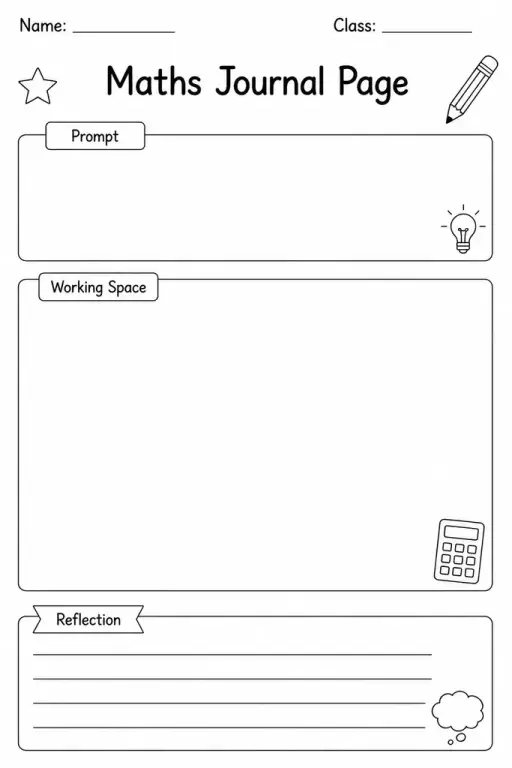
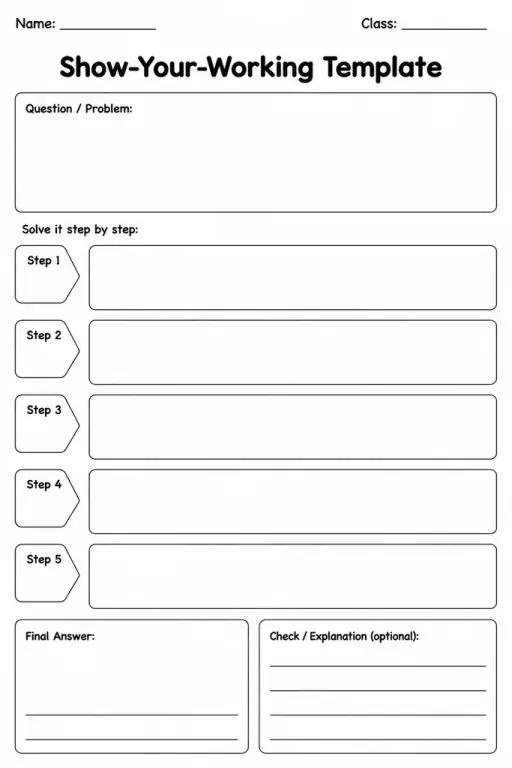
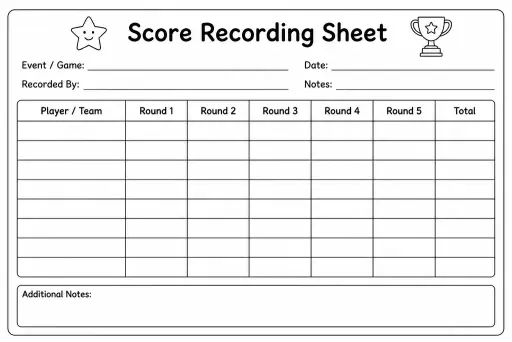
The Maths Investigation Recording Sheet is an open-ended blank frame designed to support student-led mathematical enquiry at any level from grade 3 to grade 8. It provides clearly labelled sections — question/aim, prediction, method, results table, patterns noticed, and conclusion — without prescribing the content, so it fits number investigations, geometry explorations, data-gathering tasks, and everything in between. Teachers use it to scaffold independent research tasks and problem-posing activities, while students appreciate having a consistent structure that mirrors real mathematical practice. The neutral layout keeps focus on the thinking rather than the presentation, making it equally useful for informal classroom explorations or assessed investigations.
Learning objectives
- Develop habits of structured mathematical inquiry from question to conclusion
- Practise recording methods and results clearly and systematically
- Encourage pattern recognition and generalisation from collected data
- Support independent and collaborative investigation skills
- Build experience writing conclusions grounded in mathematical evidence
- Connect procedural work to conceptual understanding through reflection
How to use this template
- Download and print one sheet per investigation, or display it digitally for students working on tablets.
- Write the investigation question or aim in the top section before any work begins.
- Complete the prediction section independently, encouraging students to commit to a hypothesis first.
- Work through the investigation and record results in the blank table or space provided.
- Finish by writing a conclusion that refers back to the original question and any patterns found.
Classroom & home ideas
- Use it during a 'maths rich task' lesson where students choose their own numbers to explore a conjecture (e.g. 'Do odd numbers always…?').
- Assign it for a homework investigation — students gather data at home (measuring, counting) and record findings in the sheet.
- Run a class gallery walk where completed sheets are posted on walls and peers leave sticky-note feedback on each other's conclusions.
- Introduce it early in the year as a shared-writing activity, filling in each section together before students use it solo.
- Archive completed sheets in student maths portfolios to demonstrate growth in reasoning and written explanation over the year.
Curriculum standards
Cambridge
- TWM.03ConjecturingCambridge Primary Mathematics (0096) — Stage 2 › Thinking and Working Mathematically
Learning objectives © UCLES (Cambridge University Press & Assessment), quoted with attribution.
Frequently asked questions
Is this sheet suitable for open-ended tasks as well as structured ones?
Yes. The sections are labelled but completely blank inside, so students can expand, shrink, or skip areas depending on whether the investigation is tightly defined or fully open-ended.
Can two students share one sheet for a partner investigation?
Definitely. The layout works for solo, pair, or small-group work. For pairs, each student can fill in their own prediction section before comparing notes during the results stage.
How is this different from a science experiment sheet?
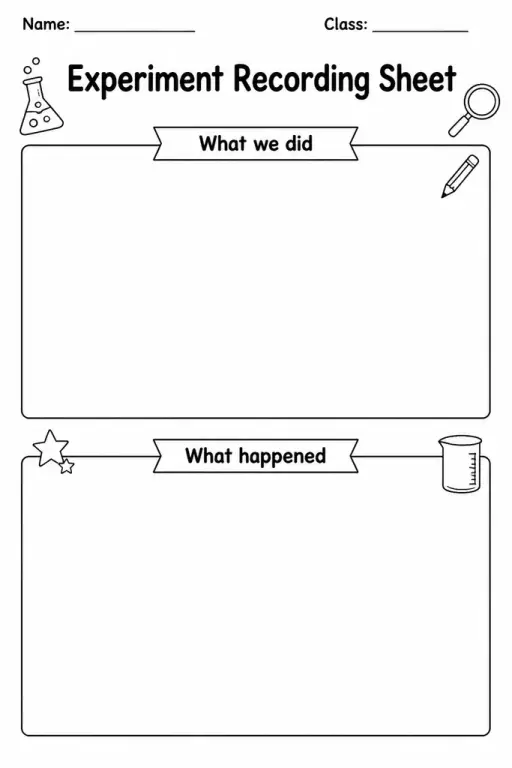
This version uses maths-specific language (conjecture, counter-example, generalisation) in the prompt areas, and the results section is designed for numerical tables and pattern spotting rather than scientific observations.
What topics work best with this recording sheet?
Number patterns, multiples and factors, shape investigations, probability experiments, measurement comparisons, and data-collection projects all fit the open frame well.
More worksheets like this
Likes & comments
See what other teachers think and share a helpful note.
Loading likes and comments…
Worksheet Studio
Open Worksheet StudioNeed a different version? Make your own.
Generate a fresh worksheet for any grade, topic and language. Free.
 Home
 All solutions
 Pricing
 About us
 KiwiBee for Non-profits
 Events & webinars
 For big organisations
 For schools
 For centers
 For team leaders
 For teachers
 Resources
 Printable worksheets
 Interactive simulations
 Teacher tools
 Ideas and research


