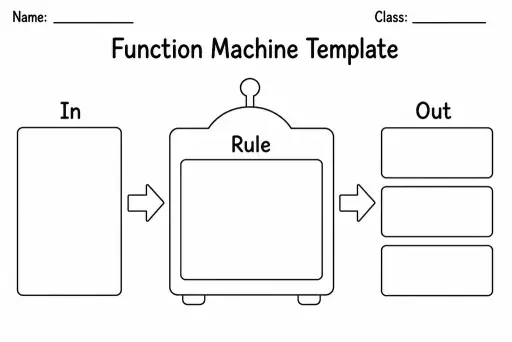
Function Machine Template
Math Templates
Ages 4–11
——
KiwiBee uses optional Google Analytics, Google Ads, and Meta Pixel cookies to understand adult visitors, measure completed sign-ups, and improve campaigns. Essential cookies always stay on. OpenAI’s ChatGPT Ads Pixel also measures page views and completed enquiries after advertising consent, and may use hashed contact details for matching. Privacy policy

A column addition grid is a lined, place-value-aligned working template that gives every digit its own clearly labelled column — ones, tens, hundreds, and beyond. Students write each addend on a separate row, staying within the column boundaries, so carrying and regrouping happen naturally in the correct position rather than wandering across the page. For grades 1–5, misaligned digits are one of the leading causes of arithmetic errors. This blank grid removes that friction: the vertical columns act as invisible guardrails, keeping hundreds above hundreds and ones above ones without the student having to draw their own lines. Teachers use it for whole-class direct instruction on an enlarged copy, while students use their own sheets for independent practice, homework, or assessment preparation. It is equally useful for subtraction or mixed addition-and-subtraction column work.
The standard template provides columns labelled Th (thousands), H (hundreds), T (tens), and O (ones), plus a small carry row at the top of each column — enough for additions up to 9,999 + 9,999. A five-column version for ten-thousands is available for grade-5 extension work.
Yes. The same column alignment that helps with addition supports subtraction with regrouping. Write the larger number on the top row, the number to subtract below it, and draw a minus sign at the left — the column structure handles the rest.
This is precisely the error the grid is designed to make visible. Pause, count the place-value position of the misplaced digit, and slide it into the correct column. After a few corrections, most students self-monitor and check their alignment before adding.
Yes — even fluent calculators benefit from the grid when working with larger numbers (five or six digits), decimals aligned to a decimal point, or when checking working during assessments. Many teachers keep laminated copies at maths stations year-round.
See what other teachers think and share a helpful note.
Generate a fresh worksheet for any grade, topic and language. Free.
 Home
Home All solutions
 Pricing
 About us
 KiwiBee for Non-profits
 Events & webinars
 For big organisations
 For schools
 For centers
 For team leaders
 For teachers
 AI and resources
 Resources
 Printable worksheets
 Lesson Packs
 Interactive simulations
 Teacher tools
 AI studio
 Ideas and research