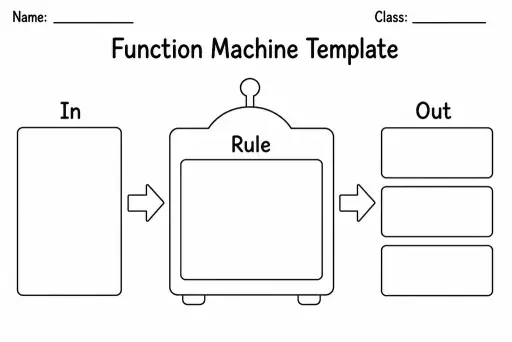
Function Machine Template
Math Templates
Ages 4–11
——
KiwiBee uses optional Google Analytics, Google Ads, and Meta Pixel cookies to understand adult visitors, measure completed sign-ups, and improve campaigns. Essential cookies always stay on. OpenAI’s ChatGPT Ads Pixel also measures page views and completed enquiries after advertising consent, and may use hashed contact details for matching. Privacy policy

The Protractor Practice Circle template is a clean, large printed circle with a clearly marked centre point and a flat baseline diameter, ready for students to lay a real protractor on top and practise measuring or drawing angles. No angles are pre-drawn — the blank circle invites students to mark their own rays, measure to the nearest degree, and label each angle directly on the page. Grades 4–8 use it to build the muscle memory of aligning the protractor's origin and baseline before reading the scale, a step beginners routinely skip. Teachers use one copy per student during the initial protractor lesson and revisit it as a warm-up throughout the geometry unit; parents find it invaluable for at-home practice without needing extra materials.
A standard 10 cm (180°) or 15 cm (360°) semicircular protractor fits the printed circle well. The circle is sized so the baseline diameter is slightly longer than most common school protractors, giving clear alignment room.
Yes. Because the template uses a full circle, students can draw rays that create reflex angles (greater than 180°) by measuring the larger arc between two rays, which is harder to practise on a standard straight-line template.
Ideal for beginners. The large centre dot and pre-printed baseline remove two common errors — misplacing the origin and tilting the baseline — so students focus on reading the scale correctly.
Students can annotate the PDF on a tablet using a stylus, but physical protractor practice requires a printed copy. We recommend printing at 100% (no scaling) to preserve the circle's calibrated proportions.
See what other teachers think and share a helpful note.
Generate a fresh worksheet for any grade, topic and language. Free.
 Home
Home All solutions
 Pricing
 About us
 KiwiBee for Non-profits
 Events & webinars
 For big organisations
 For schools
 For centers
 For team leaders
 For teachers
 AI and resources
 Resources
 Printable worksheets
 Lesson Packs
 Interactive simulations
 Teacher tools
 AI studio
 Ideas and research