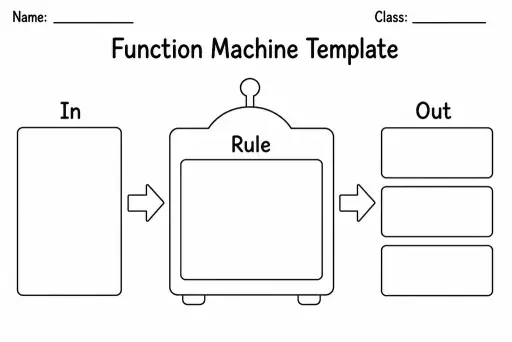
Function Machine Template
Math Templates
Ages 4–11
——
KiwiBee uses optional Google Analytics, Google Ads, and Meta Pixel cookies to understand adult visitors, measure completed sign-ups, and improve campaigns. Essential cookies always stay on. OpenAI’s ChatGPT Ads Pixel also measures page views and completed enquiries after advertising consent, and may use hashed contact details for matching. Privacy policy

The Place Value Mat is a large-format, blank sorting mat designed for students in grades 1–5 to lay physical base-ten manipulatives—flats (hundreds), rods (tens), and unit cubes (ones)—directly on the corresponding labelled sections. Where a place value chart is for writing digits, this mat is for hands-on building: students physically place, move, and regroup concrete objects, turning an abstract number into something they can touch and rearrange. Teachers laminate class sets so students can use a grease pencil or dry-erase marker to record the digit for each column after building the number with blocks. The mat's wide column areas accommodate even large handfuls of unit cubes without crowding, and the landscape orientation matches the standard left-to-right reading of numbers.
Standard base-ten blocks (plastic or wooden flats, rods, and unit cubes) are the primary fit. You can also use bundled craft sticks (ones and tens bundles) or drawn squares and lines as a low-cost alternative.
The chart is for writing digits and suits pencil-and-paper tasks. The mat is wider, designed for physically placing objects, and supports concrete-manipulative learning before students move to written notation.
Laminating is strongly recommended for classroom use. Students can then write on the mat with dry-erase markers and wipe it clean, saving paper and allowing the mat to survive the school year.
The standard mat covers Hundreds, Tens, and Ones. For thousands, simply tape or clip a Thousands column extension to the left edge, or use the Place Value Chart with Decimals template for higher and lower values.
See what other teachers think and share a helpful note.
Generate a fresh worksheet for any grade, topic and language. Free.
 Home
Home All solutions
 Pricing
 About us
 KiwiBee for Non-profits
 Events & webinars
 For big organisations
 For schools
 For centers
 For team leaders
 For teachers
 AI and resources
 Resources
 Printable worksheets
 Lesson Packs
 Interactive simulations
 Teacher tools
 AI studio
 Ideas and research