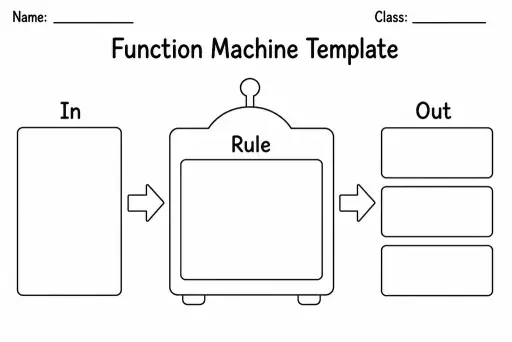
Function Machine Template
Math Templates
Ages 4–11
——
KiwiBee uses optional Google Analytics, Google Ads, and Meta Pixel cookies to understand adult visitors, measure completed sign-ups, and improve campaigns. Essential cookies always stay on. OpenAI’s ChatGPT Ads Pixel also measures page views and completed enquiries after advertising consent, and may use hashed contact details for matching. Privacy policy

The Place Value Chart is a blank three-column template labelled Hundreds, Tens, and Ones (H-T-O) that helps students in grades 1–5 decompose whole numbers and record their digits in the correct positions. Unlike a printed example, this blank chart is filled in fresh for every number students work with, making the abstract idea of digit position concrete and repeatable. Teachers use it during introductory place value lessons, during multi-digit addition and subtraction practice, and as a reference strip taped to desks for students who need extra support. The clean column layout is intentionally simple so students focus on the mathematics rather than the decoration. Print a class set for a single lesson or laminate individual copies so students can write with dry-erase markers and reset in seconds.
The three-column H-T-O layout covers whole numbers from 1 to 999. For numbers above 999, use the Place Value Chart with Decimals template (which adds a Thousands column) or extend by adding columns manually.
Yes. Simply ignore the Hundreds column and work only in the Tens and Ones columns. The blank chart does not force students to fill every column.
Place the physical blocks on or next to the chart, then count each type and write the digit in the matching column. This bridges the concrete block representation with written symbolic notation.
The cells are sized for comfortable writing with a pencil in grades 1–2. If you need larger cells for kindergarten or students with fine-motor challenges, print at 120–130 % scale.
See what other teachers think and share a helpful note.
Generate a fresh worksheet for any grade, topic and language. Free.
 Home
Home All solutions
 Pricing
 About us
 KiwiBee for Non-profits
 Events & webinars
 For big organisations
 For schools
 For centers
 For team leaders
 For teachers
 AI and resources
 Resources
 Printable worksheets
 Lesson Packs
 Interactive simulations
 Teacher tools
 AI studio
 Ideas and research