Printable template
Part-Part-Whole Template
Cherry / number-bond split, blank.
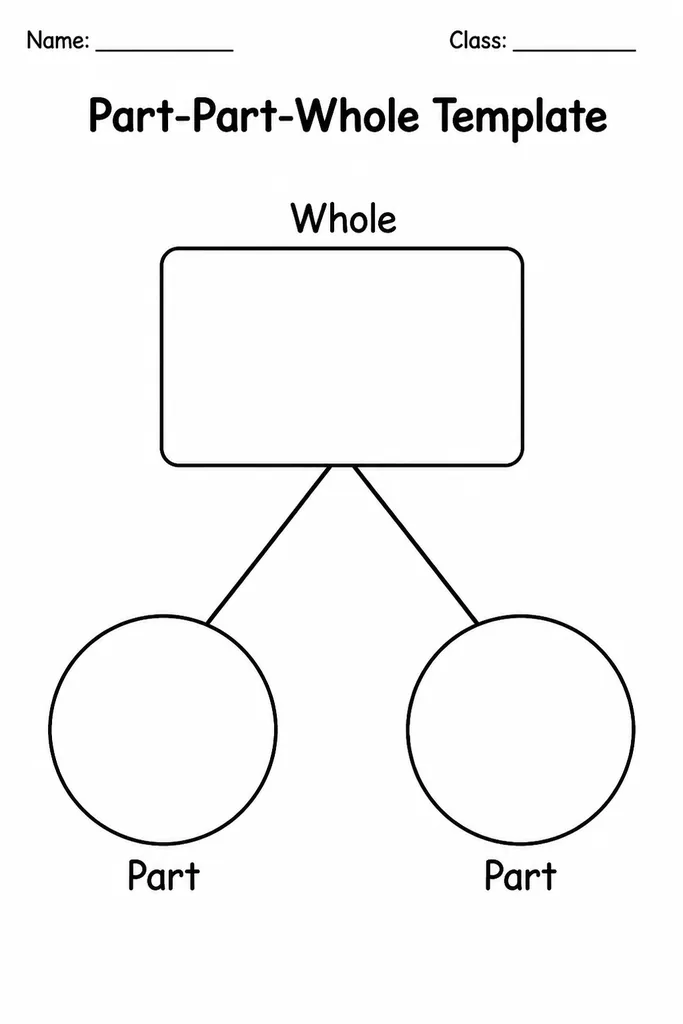
The Part-Part-Whole Template — sometimes called a number bond or cherry diagram — is a blank graphic organizer with one large circle at the top connected by lines to two smaller circles below. Students write the whole number in the top circle and the two parts that make it up in the lower circles, making the additive relationship between numbers visible and explicit. Kindergarten through grade 3 teachers use it to teach number composition, introduce fact families, and bridge addition to subtraction. Because the same diagram handles both operations — fill in different circles depending on what is known and unknown — it naturally introduces the concept of algebraic missing-value thinking. Parents find it equally useful at home: a simple, low-prep visual that turns number talks into pencil-and-paper practice without needing manipulatives.
Learning objectives
- Decompose whole numbers into two parts in multiple ways
- Connect addition and subtraction as inverse operations
- Build fact-family fluency for numbers within 20
- Introduce missing-addend and missing-subtrahend thinking
- Develop part-whole reasoning as a foundation for algebra
- Represent word problems visually before writing equations
How to use this template
- Download and print; a laminated copy allows repeated use with a dry-erase marker.
- For addition: write both parts in the lower circles and find the whole to write at the top.
- For subtraction: write the whole at the top and one known part below; find the missing part.
- Have students write all four related equations beside the diagram to form the complete fact family.
- Use a new copy for each number or context, or reuse the laminated version by wiping it clean.
Classroom & home ideas
- Fact-family fluency: after completing one diagram for the number 7, students write all four equations (3+4, 4+3, 7−3, 7−4) and circle the relationship.
- Word-problem scaffold: before writing any equations, students sketch the part-part-whole diagram to identify what is known and what must be found.
- Number of the day: each morning, students decompose the date number in as many ways as possible, filling one diagram per decomposition on a half-sheet.
- Cooperative pairs: one partner writes the whole, the other writes one part; both must agree on the missing part before recording it.
- Differentiated practice: struggling learners use manipulatives to fill in both parts first, while advanced students work with three-digit numbers and partial information.
Skills practised
Frequently asked questions
What is the difference between a part-part-whole diagram and a number bond?
They represent the same relationship. 'Number bond' is the term used in Singapore Math and many UK curricula; 'part-part-whole' is the label more common in US standards-based programs. This template works for both conventions.
Can this template be used for numbers larger than 20?
Yes — the blank circles have no built-in limit. The template is equally useful for two- and three-digit number decomposition in grades 2–3 (e.g., 100 = 60 + 40).
How does this template support word problem solving?
Students identify whether the unknown is the whole or one of the parts, place the known values, and solve for the blank. This prevents the common mistake of always adding when they see two numbers together.
Is one circle always the 'whole' and two always the 'parts'?
By convention, yes — the top or larger circle holds the whole, and the two lower or smaller circles hold the parts. Keeping this consistent helps students form a reliable mental model for the operation.
Likes & comments
See what other teachers think and share a helpful note.
Create more worksheets in our Worksheet Studio
Generate fresh worksheets for any grade, topic, and language — free.
Open the Worksheet StudioRelated worksheets
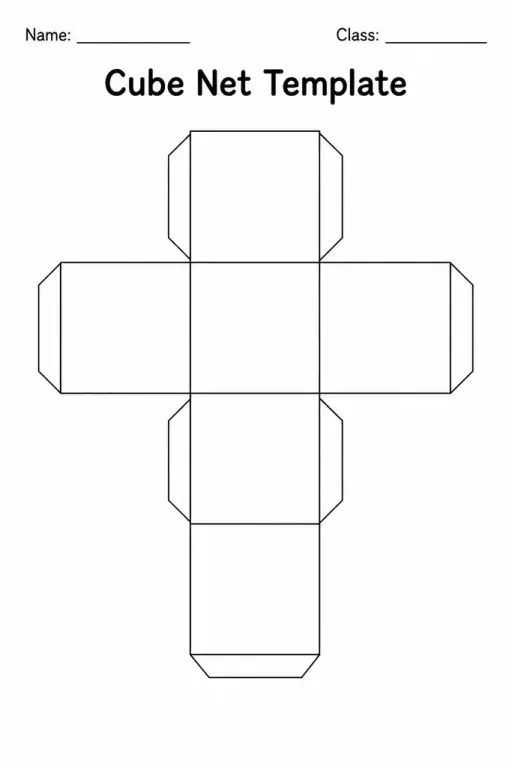
Cube Net Template
Triangular / Tessellation Grid
Hundred Square (Blank)
Maths Journal Page
Twenty Frame
Times-Table Practice Template
Column Addition Grid
 For big organisations
 For schools
 For centers
 For team leaders
 For teachers
 AI and resources
 Printable worksheets
 Interactive simulations
 Teacher tools
 AI studio
 Ideas and research