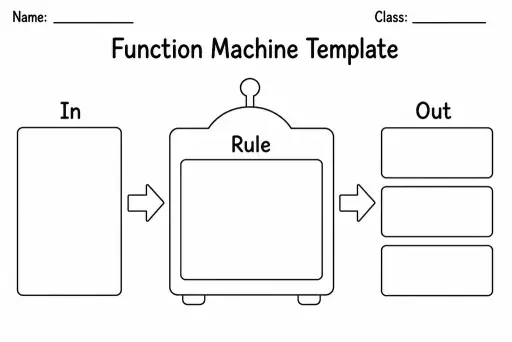
Function Machine Template
Math Templates
Ages 4–11
——
KiwiBee uses optional Google Analytics, Google Ads, and Meta Pixel cookies to understand adult visitors, measure completed sign-ups, and improve campaigns. Essential cookies always stay on. OpenAI’s ChatGPT Ads Pixel also measures page views and completed enquiries after advertising consent, and may use hashed contact details for matching. Privacy policy

The Blank Number Track is a horizontal strip of empty, equally spaced boxes that young learners fill in themselves, turning the abstract idea of a number sequence into something physical and personal. Unlike a pre-printed number line, this track invites PreK through Grade 2 students to write each digit in order, reinforcing numeral formation alongside number-sequence fluency. Teachers laminate it so children can fill it with a dry-erase marker and reset it for the next activity. Parents use it on kitchen tables for counting practice, and classroom aides tape strips together to build longer tracks across a whiteboard. The act of writing the numerals, rather than simply reading them, deepens the connection between the symbol and its position — an essential foundation before skip-counting, addition, and subtraction are introduced.
Each strip has 20 boxes, and two strips fit on one A4 page. Tape strips together to build tracks of any length.
For PreK and Kindergarten, starting at 1 is more intuitive. Introduce the 0 box when students are ready to explore zero as a number, typically in late Kindergarten.
Yes — for Grade 2 extension, start the first box at –5 or another negative and count up through zero. It is a powerful visual for introducing the concept.
A number track has enclosed boxes representing whole-number positions. A number line is a continuous line with marks. Tracks are better for very young learners because each number occupies its own discrete space.
See what other teachers think and share a helpful note.
Generate a fresh worksheet for any grade, topic and language. Free.
 Home
Home All solutions
 Pricing
 About us
 KiwiBee for Non-profits
 Events & webinars
 For big organisations
 For schools
 For centers
 For team leaders
 For teachers
 AI and resources
 Resources
 Printable worksheets
 Lesson Packs
 Interactive simulations
 Teacher tools
 AI studio
 Ideas and research