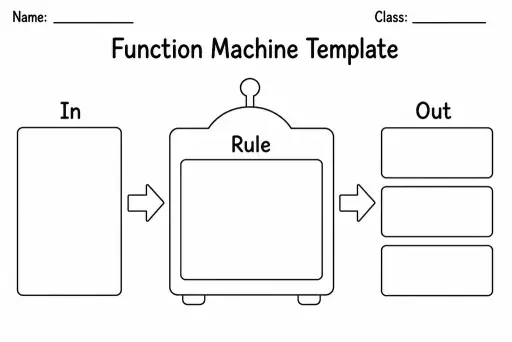
Function Machine Template
Math Templates
Ages 4–11
——
KiwiBee uses optional Google Analytics, Google Ads, and Meta Pixel cookies to understand adult visitors, measure completed sign-ups, and improve campaigns. Essential cookies always stay on. OpenAI’s ChatGPT Ads Pixel also measures page views and completed enquiries after advertising consent, and may use hashed contact details for matching. Privacy policy

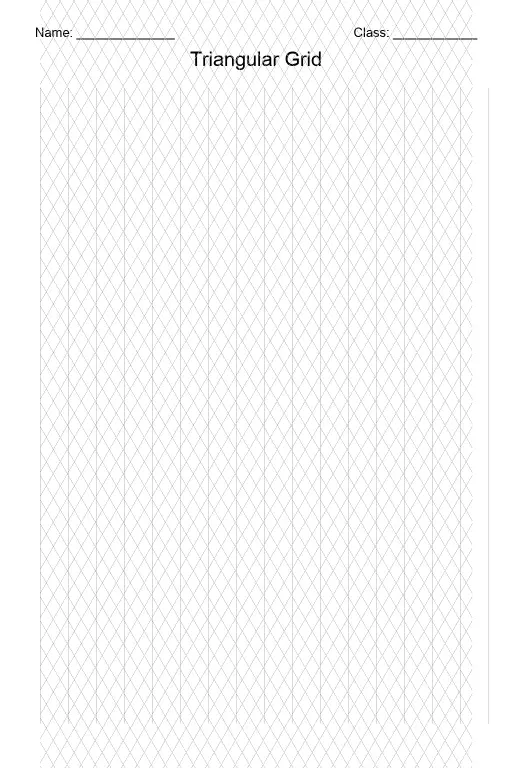
Isometric Grid Paper is a full triangular line grid that prints the complete network of 60-degree guide lines across the page, giving students an immediate structural scaffold for three-dimensional technical drawing. Unlike the dot version, where students must mentally connect anchor points, this template makes every edge of every equilateral triangle visible as a printed line — ideal for beginners to 3D sketching and for technical design work that demands precision. Students in grades 4–8 use it for engineering and design-technology projects, maths lessons on volume and surface area, and architecture-inspired art activities. The continuous line grid also makes it easier to count units on complex shapes, simplifying cube-counting and volume estimation tasks. Teachers print class sets when introducing isometric projection for the first time.
Isometric grid paper prints full triangular lines across the page, making every guide line visible. Isometric dot paper only marks the intersection points. The full grid gives beginners more structure; experienced drawers often prefer the cleaner look of the dot version.
The lines run at 30 degrees above horizontal (or equivalently 60 degrees from vertical), which is the standard angle for isometric projection used in engineering and technical drawing.
Yes — the isometric grid is used in both subjects. In art it supports geometric illustration, tessellations, and optical-illusion design; in maths it supports 3D shape work and volume calculations.
A fine 0.5 mm mechanical pencil works well for neat technical lines. For presentation work, a 0.3 mm fine-liner on top of a pencil under-sketch gives clean, confident edges.
See what other teachers think and share a helpful note.
Generate a fresh worksheet for any grade, topic and language. Free.
 Home
Home All solutions
 Pricing
 About us
 KiwiBee for Non-profits
 Events & webinars
 For big organisations
 For schools
 For centers
 For team leaders
 For teachers
 AI and resources
 Resources
 Printable worksheets
 Lesson Packs
 Interactive simulations
 Teacher tools
 AI studio
 Ideas and research