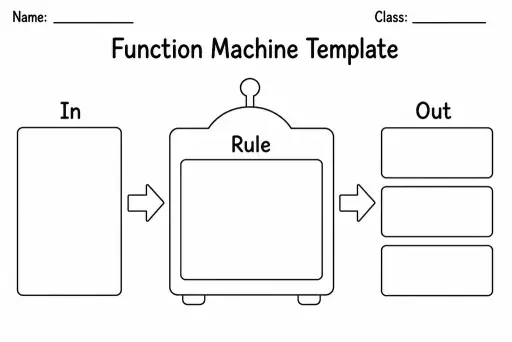
Function Machine Template
Math Templates
Ages 4–11
——
KiwiBee uses optional Google Analytics, Google Ads, and Meta Pixel cookies to understand adult visitors, measure completed sign-ups, and improve campaigns. Essential cookies always stay on. OpenAI’s ChatGPT Ads Pixel also measures page views and completed enquiries after advertising consent, and may use hashed contact details for matching. Privacy policy

Fraction circles (blank) is a printable math template featuring a set of same-sized circles, each left completely empty so students draw their own dividing lines, label each sector, and color the pieces. Grades 2–6 learners use the circular format to develop an intuitive grasp of fractions as parts of a whole shape—a context that feels natural because of everyday objects like pizza and pie. The circular model complements strip and number-line representations, giving students a second visual anchor for the same concepts. Teachers use the template for whole-class demonstrations on the document camera, small-group manipulative work, and individual assessments. Parents find it a low-prep way to revisit fractions at home: print one sheet, hand a child a pencil, and talk through halves and quarters before moving on to harder denominators. Because each circle is blank, a single template supports differentiation—one student models thirds while another models sixths on the same page.
For halves and quarters, folding a printed circle works well. For thirds, sixths, or fifths, a protractor or pre-drawn dot at the center helps. Some teachers pre-mark the center dot before printing.
Grades 2–3 typically focus on halves, thirds, and fourths. Grades 4–6 extend to sixths, eighths, and twelfths. The blank format means you choose the denominator set that fits your unit.
Yes. The circles are blank, so a parent simply asks the child to fold or draw lines to make equal pieces. Counting and labeling pieces together requires no advanced math knowledge.
It works well for a visual introduction to the idea, but it requires careful drawing to be precise. For rigorous comparison, pair circle models with fraction strips or a number line to cross-check.
See what other teachers think and share a helpful note.
Generate a fresh worksheet for any grade, topic and language. Free.
 Home
Home All solutions
 Pricing
 About us
 KiwiBee for Non-profits
 Events & webinars
 For big organisations
 For schools
 For centers
 For team leaders
 For teachers
 AI and resources
 Resources
 Printable worksheets
 Lesson Packs
 Interactive simulations
 Teacher tools
 AI studio
 Ideas and research