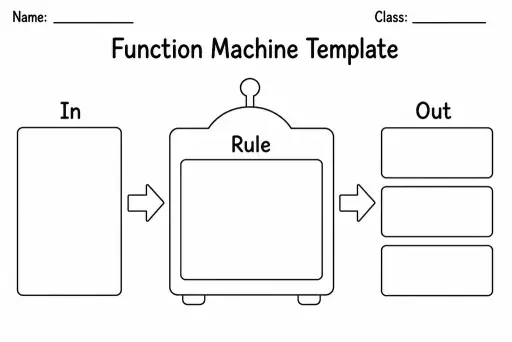
Function Machine Template
Math Templates
Ages 4–11
——
KiwiBee uses optional Google Analytics, Google Ads, and Meta Pixel cookies to understand adult visitors, measure completed sign-ups, and improve campaigns. Essential cookies always stay on. OpenAI’s ChatGPT Ads Pixel also measures page views and completed enquiries after advertising consent, and may use hashed contact details for matching. Privacy policy

A blank thermometer template features a vertical thermometer outline with a numbered scale but an empty mercury column — students shade or mark the column to show a given temperature, or they read a pre-shaded version and record the value. Grades 1 through 6 use it across science and maths lessons: early grades practise reading scales in whole numbers, while upper grades work with negative temperatures, decimal readings, and conversion between Celsius and Fahrenheit. Teachers reach for the template during weather units, data collection activities, and number-line extension lessons because the thermometer is essentially a vertical number line. That connection helps students understand positive and negative integers, reading scales, and estimation. Parents use it for real-world maths — printing a copy and asking children to record the outdoor temperature each morning builds data literacy alongside arithmetic skills.
The standard version shows a Celsius scale. A dual-scale version with both Celsius and Fahrenheit labels is available in the same download for grades tackling unit conversion.
Yes. The scale extends below zero, making the thermometer an ideal first encounter with negative integers positioned on a vertical number line.
The default scale marks every two degrees with numbered intervals every ten degrees. Students can estimate and record half-degree or one-degree readings for additional challenge.
Absolutely. It is equally at home in a science lesson on states of matter, a geography unit on climate, or a maths lesson on reading scales and interpreting data.
See what other teachers think and share a helpful note.
Generate a fresh worksheet for any grade, topic and language. Free.
 Home
Home All solutions
 Pricing
 About us
 KiwiBee for Non-profits
 Events & webinars
 For big organisations
 For schools
 For centers
 For team leaders
 For teachers
 AI and resources
 Resources
 Printable worksheets
 Lesson Packs
 Interactive simulations
 Teacher tools
 AI studio
 Ideas and research