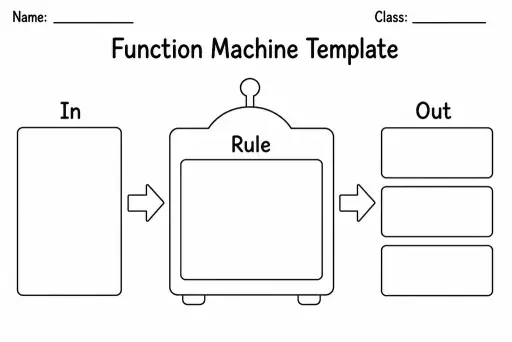
Function Machine Template
Math Templates
Ages 4–11
——
KiwiBee uses optional Google Analytics, Google Ads, and Meta Pixel cookies to understand adult visitors, measure completed sign-ups, and improve campaigns. Essential cookies always stay on. OpenAI’s ChatGPT Ads Pixel also measures page views and completed enquiries after advertising consent, and may use hashed contact details for matching. Privacy policy

This blank line graph template provides a clean set of axes with an evenly spaced grid, giving students in grades 3–8 a professional-looking scaffold for plotting continuous data without the distraction of setting up their own scales. The horizontal x-axis and vertical y-axis are clearly printed with tick marks, leaving the labels and scale numbers for students to define based on their specific data set. Science experiments, temperature readings, population changes, and story-problem tables all translate naturally onto this grid. Teachers use it across maths, science, and social studies lessons; older students appreciate the fine grid for more precise plots and trend analysis.
The grid comfortably fits 10–12 data points along the x-axis. For longer data sets, students can widen the intervals or use two sheets joined together.
Yes. Students simply place zero in the middle of the y-axis and extend the scale downward with negative numbers, which makes it ideal for temperature or profit-and-loss data.
It works well from grade 3 onward. For younger students, pre-label one axis before printing so they only need to plot points rather than set up the full scale.
A line graph shows change over time or continuous data trends; a bar graph compares separate categories. Use this template when your x-axis represents time or an ordered measurement.
See what other teachers think and share a helpful note.
Generate a fresh worksheet for any grade, topic and language. Free.
 Home
Home All solutions
 Pricing
 About us
 KiwiBee for Non-profits
 Events & webinars
 For big organisations
 For schools
 For centers
 For team leaders
 For teachers
 AI and resources
 Resources
 Printable worksheets
 Lesson Packs
 Interactive simulations
 Teacher tools
 AI studio
 Ideas and research