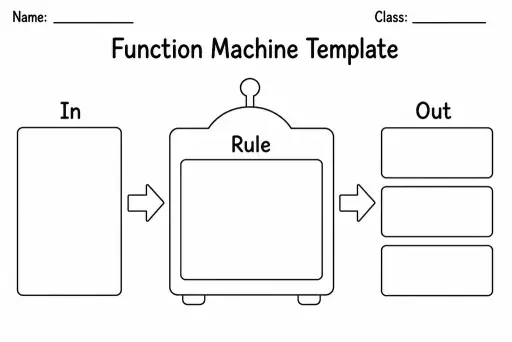
Function Machine Template
Math Templates
Ages 4–11
——
KiwiBee uses optional Google Analytics, Google Ads, and Meta Pixel cookies to understand adult visitors, measure completed sign-ups, and improve campaigns. Essential cookies always stay on. OpenAI’s ChatGPT Ads Pixel also measures page views and completed enquiries after advertising consent, and may use hashed contact details for matching. Privacy policy

The Base-Ten / Dienes Mat is a blank working mat divided into three clearly labeled columns: Hundreds, Tens, and Ones. Students in grades 1–4 place physical base-ten blocks, draw quick sketches, or write tally marks directly on the mat to build, decompose, and compare multi-digit numbers. Having a dedicated visual workspace keeps place-value thinking organized so children can see exactly how many of each unit they are working with. Teachers use it during whole-class modeling with a document camera, while students use individual copies at their seats for computation tasks, regrouping practice, and number dictation exercises. Parents find the mat just as useful at the kitchen table when a child is learning to trade ones for tens. The three-column layout matches the standard place-value chart and reinforces the correct vocabulary every time the mat is used.
Yes. Students can draw dots for ones, vertical lines for tens, and small squares for hundreds directly in each column. The mat works equally well as a draw-and-label workspace.
The three-column layout covers numbers from 0 to 999. For four-digit numbers, simply tape two mats side by side and add a Thousands label to the extra column.
Laminate a printed copy and use dry-erase markers. Alternatively, slide it into a clear plastic sleeve and write on the sleeve with a whiteboard marker.
The mat directly supports CCSS.MATH.CONTENT.1.NBT, 2.NBT, and 3.NBT standards covering place value, addition, and subtraction with regrouping.
See what other teachers think and share a helpful note.
Generate a fresh worksheet for any grade, topic and language. Free.
 Home
Home All solutions
 Pricing
 About us
 KiwiBee for Non-profits
 Events & webinars
 For big organisations
 For schools
 For centers
 For team leaders
 For teachers
 AI and resources
 Resources
 Printable worksheets
 Lesson Packs
 Interactive simulations
 Teacher tools
 AI studio
 Ideas and research