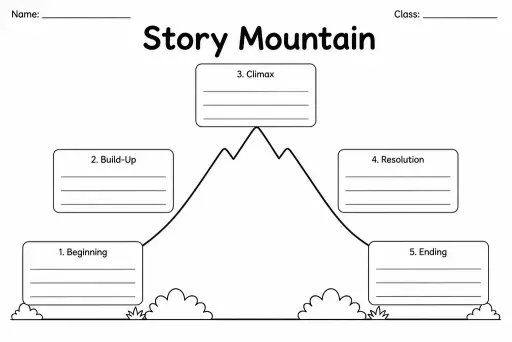
Story Mountain
Graphic Organizers
Ages 4–11
——
KiwiBee uses optional Google Analytics, Google Ads, and Meta Pixel cookies to understand adult visitors, measure completed sign-ups, and improve campaigns. Essential cookies always stay on. OpenAI’s ChatGPT Ads Pixel also measures page views and completed enquiries after advertising consent, and may use hashed contact details for matching. Privacy policy

The Student Writing Checklist is a blank success-criteria tick frame that puts the learning goals for a writing task directly in the student's hands. Unlike a pre-printed rubric, this template ships empty so that teachers and students can co-construct the criteria together at the start of a unit — a practice shown to improve ownership and writing quality across grades 1 through 8. The tick-box layout prompts students to evaluate their own draft before submitting, answering the fundamental question: 'Have I done everything I set out to do?' Parents doing home writing practice can use it equally well by listing a handful of expectations the child understands, then letting the child tick off each one. The format works for any genre — narrative, persuasive, informational, or poetry — and can be reused term after term simply by printing a new blank copy.
This template focuses on content, structure, and writing craft (what the piece says and how it is organised), while the proofreading checklist targets surface-level mechanics like spelling and punctuation.
The blank frame has space for approximately 6–10 criteria, which is enough for most writing assignments from grades 1 through 8.
Yes. For grades 1–2, keep criteria simple and visual, such as 'I drew a picture to go with my writing' or 'I used a capital letter to start.' The blank rows make it easy to pitch criteria at the right level.
Filling in the criteria together before writing sets clear targets. Students then return to the checklist after their first draft to self-assess and revise before the final submission.
See what other teachers think and share a helpful note.
Generate a fresh worksheet for any grade, topic and language. Free.
 Home
Home All solutions
 Pricing
 About us
 KiwiBee for Non-profits
 Events & webinars
 For big organisations
 For schools
 For centers
 For team leaders
 For teachers
 AI and resources
 Resources
 Printable worksheets
 Lesson Packs
 Interactive simulations
 Teacher tools
 AI studio
 Ideas and research