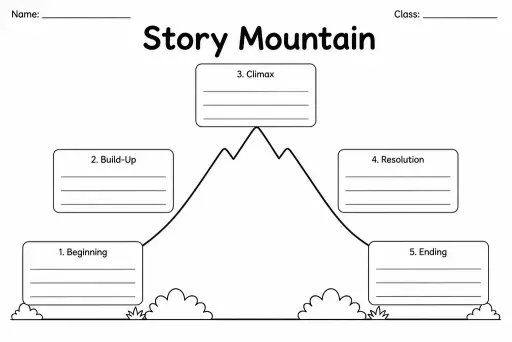
Story Mountain
Graphic Organizers
Ages 4–11
——
KiwiBee uses optional Google Analytics, Google Ads, and Meta Pixel cookies to understand adult visitors, measure completed sign-ups, and improve campaigns. Essential cookies always stay on. OpenAI’s ChatGPT Ads Pixel also measures page views and completed enquiries after advertising consent, and may use hashed contact details for matching. Privacy policy

The Boxing-Up Planner is a blank Talk-for-Writing planning template that divides a story or text into clearly labelled stacked sections — one box for each structural stage. Rooted in Pie Corbett's Talk-for-Writing approach, it asks students to think about what happens in each section of a text before writing a single sentence, making the invisible architecture of a story or information text visible and manageable. Primary school teachers introduce the boxing-up technique alongside shared reading or oral storytelling in grades 1–6. Students annotate each box with key words, simple phrases, or quick sketches rather than full sentences, so the planner works even with early or reluctant writers. Once completed, it becomes a speaking frame for retelling the text aloud and a writing frame for composition.
Talk-for-Writing is a teaching approach developed by Pie Corbett that uses oral rehearsal to build writing fluency. Boxing up is the planning stage where students map the structure of a model text before innovating it into their own writing.
Yes. For a non-fiction text, each box represents a section or sub-heading (e.g. Introduction / Habitat / Diet / Interesting Facts / Summary). The stacked layout works for any text structure, fiction or non-fiction.
This blank template is flexible — teachers simply label as many boxes as the text structure needs. A simple five-part story needs five boxes; a detailed report might use seven or eight.
Yes. Younger or less confident writers can use pictures or single words in each box. The planner supports pre-writing talk and is accessible to a wide range of abilities within the same lesson.
See what other teachers think and share a helpful note.
Generate a fresh worksheet for any grade, topic and language. Free.
 Home
Home All solutions
 Pricing
 About us
 KiwiBee for Non-profits
 Events & webinars
 For big organisations
 For schools
 For centers
 For team leaders
 For teachers
 AI and resources
 Resources
 Printable worksheets
 Lesson Packs
 Interactive simulations
 Teacher tools
 AI studio
 Ideas and research