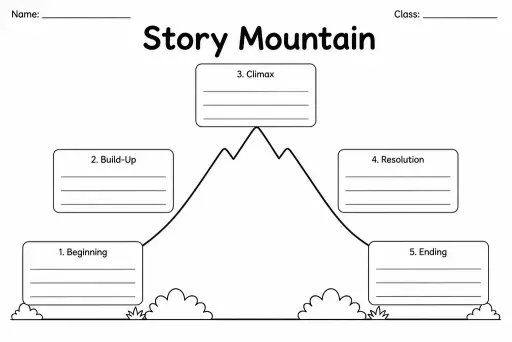
Story Mountain
Graphic Organizers
Ages 4–11
——
KiwiBee uses optional Google Analytics, Google Ads, and Meta Pixel cookies to understand adult visitors, measure completed sign-ups, and improve campaigns. Essential cookies always stay on. OpenAI’s ChatGPT Ads Pixel also measures page views and completed enquiries after advertising consent, and may use hashed contact details for matching. Privacy policy

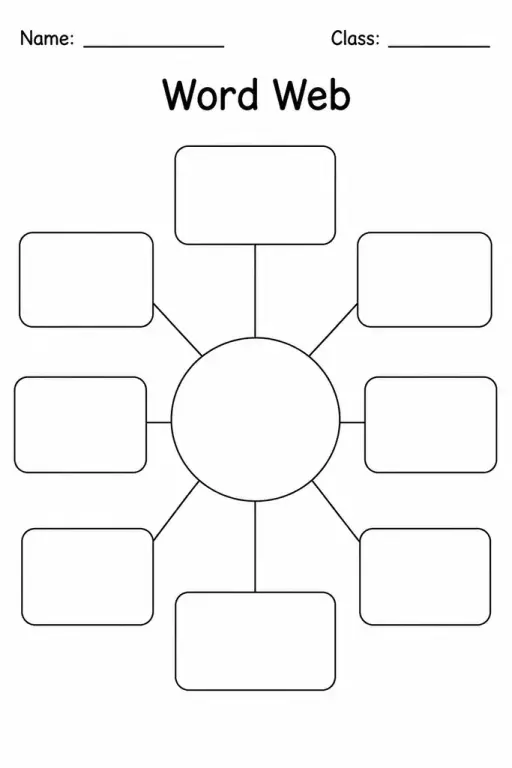
A Mind Map or Spider Diagram centers one main idea inside a large circle and radiates blank branches outward for related thoughts, subtopics, or supporting details. Sometimes called a spider diagram because the branches resemble legs spreading from a body, this format makes the structure of ideas instantly visible. Students in grades 2 through 8 use it for brainstorming, pre-writing, vocabulary exploration, and concept review. Because there are no labels or prompts on the template, it can represent any web of ideas — from character traits in a novel to the causes of a historical event to the properties of geometric shapes. Teachers and students simply write the central topic themselves before filling each branch.
The printable comes with several pre-drawn branches from the central circle. Students can add more lines by hand if they need additional space.
The terms are often used interchangeably. A spider diagram typically shows one level of branches, while a mind map may include sub-branches. This template supports both styles.
Yes. From grade 2 onward, students can draw or write in each branch. For grade 1, a teacher can scribe while students dictate ideas.
For many students, especially visual learners, a mind map works better as a first-draft planner. The branches can map directly to paragraphs once the student is ready to write.
See what other teachers think and share a helpful note.
Generate a fresh worksheet for any grade, topic and language. Free.
 Home
Home All solutions
 Pricing
 About us
 KiwiBee for Non-profits
 Events & webinars
 For big organisations
 For schools
 For centers
 For team leaders
 For teachers
 AI and resources
 Resources
 Printable worksheets
 Lesson Packs
 Interactive simulations
 Teacher tools
 AI studio
 Ideas and research