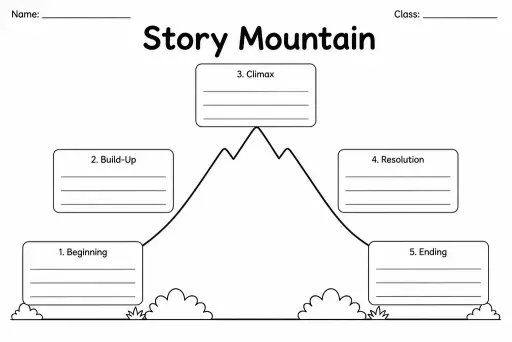
Story Mountain
Graphic Organizers
Ages 4–11
——
KiwiBee uses optional Google Analytics, Google Ads, and Meta Pixel cookies to understand adult visitors, measure completed sign-ups, and improve campaigns. Essential cookies always stay on. OpenAI’s ChatGPT Ads Pixel also measures page views and completed enquiries after advertising consent, and may use hashed contact details for matching. Privacy policy

The Recount Planner is a blank chronological writing-frame template that provides an ordered sequence of labelled sections — orientation, events in order, and a personal reflection or closing — to guide students through planning a recount before they write. Whether recounting a school trip, a science experiment, a sports day, or a personal experience, students drop their key ideas into each timed section and end up with a ready-to-use writing plan in minutes. Aimed at grades 1–5, this template suits the earliest writers who need a simple three-part frame as much as it suits older students who need to plan a detailed procedural recount with multiple ordered events. Teachers and parents both use it: classroom teachers hand it out before shared writing sessions, while parents use it at home to help children record holiday adventures or family events in proper sequence.
A recount describes real events that actually happened, written in the past tense and in the order they occurred. A story can be fictional and often includes invented characters and a narrative problem-resolution arc.
This blank template is flexible. For younger writers in grades 1–2, three event boxes is usually enough. For grades 3–5 recounting a longer trip or sequence, four to six boxes give adequate space for detail.
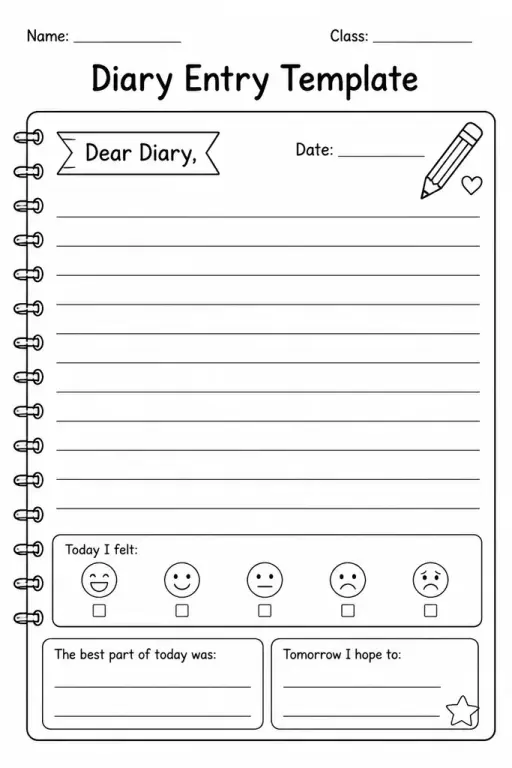
Yes. Personal recounts (a diary entry, holiday narrative) and impersonal recounts (a history account, a science observation log) both follow a chronological structure, so the same planner frame suits both.
It works well for EAL learners because the labelled sections reduce cognitive load — students think about content and sequence separately from grammar and sentence construction. Time-connective prompts in each box also model the key language.
See what other teachers think and share a helpful note.
Generate a fresh worksheet for any grade, topic and language. Free.
 Home
Home All solutions
 Pricing
 About us
 KiwiBee for Non-profits
 Events & webinars
 For big organisations
 For schools
 For centers
 For team leaders
 For teachers
 AI and resources
 Resources
 Printable worksheets
 Lesson Packs
 Interactive simulations
 Teacher tools
 AI studio
 Ideas and research