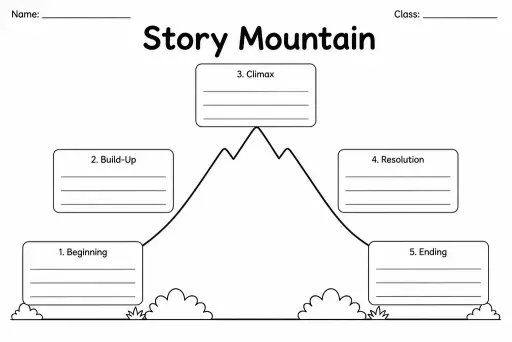
Story Mountain
Graphic Organizers
Ages 4–11
——
KiwiBee uses optional Google Analytics, Google Ads, and Meta Pixel cookies to understand adult visitors, measure completed sign-ups, and improve campaigns. Essential cookies always stay on. OpenAI’s ChatGPT Ads Pixel also measures page views and completed enquiries after advertising consent, and may use hashed contact details for matching. Privacy policy

The Flow Map (Sequence) is a blank graphic organizer made up of linked boxes arranged in a horizontal or vertical chain. Students use it to map out any process, procedure, or narrative in the correct order — from story events and science experiments to math algorithms and historical timelines. Each box holds one step, and the arrows between them make the direction of the sequence unmistakably clear. Teachers hand it out before writing assignments to help students plan paragraphs, or after reading to check comprehension of plot and procedure. Parents find it useful for guiding kids through multi-step homework routines at home. Because the boxes are completely blank, it adapts to any subject and any grade level without modification.
The standard printable has six linked boxes, which suits most classroom sequences. If you need more steps, simply tape two copies end to end or use the blank space to add extra arrows and boxes by hand.
Absolutely. The blank boxes work equally well for sequencing plot events in a story, steps in a science experiment, or stages in a historical event. The template is subject-neutral.
Yes. Early-grade students can draw pictures in each box instead of writing words, making it accessible before full literacy is established.
Yes — slip it inside a dry-erase pocket or laminate it, and students can fill it with a whiteboard marker and wipe it clean for the next activity.
See what other teachers think and share a helpful note.
Generate a fresh worksheet for any grade, topic and language. Free.
 Home
Home All solutions
 Pricing
 About us
 KiwiBee for Non-profits
 Events & webinars
 For big organisations
 For schools
 For centers
 For team leaders
 For teachers
 AI and resources
 Resources
 Printable worksheets
 Lesson Packs
 Interactive simulations
 Teacher tools
 AI studio
 Ideas and research