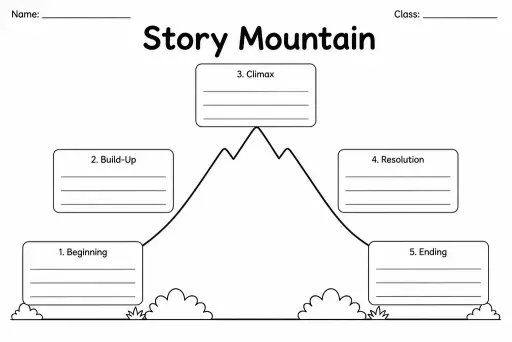
Story Mountain
Graphic Organizers
Ages 4–11
——
KiwiBee uses optional Google Analytics, Google Ads, and Meta Pixel cookies to understand adult visitors, measure completed sign-ups, and improve campaigns. Essential cookies always stay on. OpenAI’s ChatGPT Ads Pixel also measures page views and completed enquiries after advertising consent, and may use hashed contact details for matching. Privacy policy

The 6-Panel Comic Strip template fills a full page with six evenly sized blank frames — enough room to develop a real plot arc with rising action, climax, and resolution. Each panel includes a ruled caption line underneath, giving students space to write dialogue, sound effects, or scene descriptions without crowding the artwork. It suits grades 1 through 8 and adapts to a wide range of projects: creative writing assignments, graphic-novel units, social-emotional storytelling about conflict resolution, or visual book reports. Six panels naturally support a five-act mini-narrative with a title panel, making it ideal for students ready to move beyond the three-beat strip into richer sequential storytelling. Teachers often laminate a copy as a reusable planning board for class brainstorms.
The six-panel layout gives more room to build plot — students can show introduction, rising action, climax, falling action, and resolution without rushing, making it better for longer or more complex stories.
For grades 1–3, consider printing the template at larger scale (e.g. two panels per A4 page) so small hands have room to draw comfortably. Older students can work at standard size.
Yes — the six sequential frames work well as a lightweight storyboard. Add camera-direction notes in the caption lines (close-up, wide shot) to turn it into a basic production planner.
Groups of 2–3 work well: one student takes panels 1–2, another 3–4, and a third 5–6. Plan characters and plot together first to keep the strip cohesive.
See what other teachers think and share a helpful note.
Generate a fresh worksheet for any grade, topic and language. Free.
 Home
Home All solutions
 Pricing
 About us
 KiwiBee for Non-profits
 Events & webinars
 For big organisations
 For schools
 For centers
 For team leaders
 For teachers
 AI and resources
 Resources
 Printable worksheets
 Lesson Packs
 Interactive simulations
 Teacher tools
 AI studio
 Ideas and research