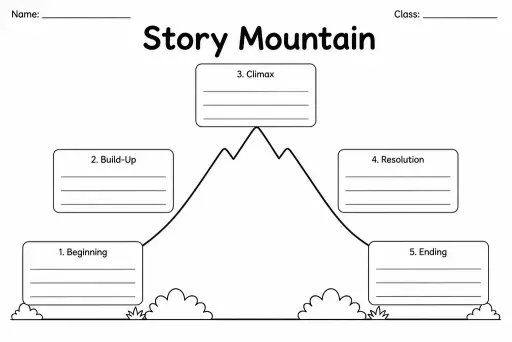
Story Mountain
Graphic Organizers
Ages 4–11
——
KiwiBee uses optional Google Analytics, Google Ads, and Meta Pixel cookies to understand adult visitors, measure completed sign-ups, and improve campaigns. Essential cookies always stay on. OpenAI’s ChatGPT Ads Pixel also measures page views and completed enquiries after advertising consent, and may use hashed contact details for matching. Privacy policy

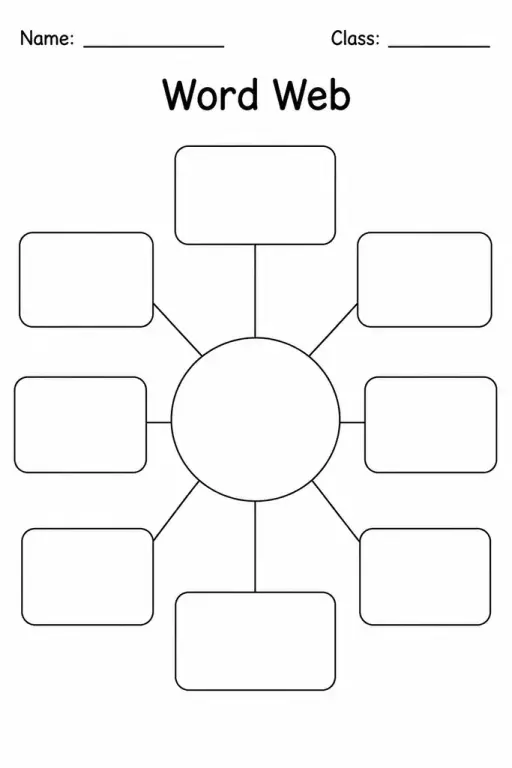
A Bubble Map places one topic in a central circle and surrounds it with smaller blank bubbles joined by short lines, each bubble holding a describing word, trait, or attribute. It is one of the eight Thinking Maps developed to train specific thinking skills — in this case, describing with adjectives and qualities. Students in grades 1 through 6 use it to build rich vocabulary around a subject before writing a descriptive paragraph, analysing a character, or exploring the properties of an object. Teachers appreciate how quickly the template makes abstract descriptions concrete and visible. Parents can print it at home to help young learners practise descriptive language around familiar objects or story characters.
The printable has several surrounding bubbles pre-drawn around the central circle. Students can easily add more by drawing their own if the topic needs extra description.
Descriptive words — adjectives, sensory details, traits, and qualities. Numbers and measurements also work when describing scientific observations.
No. A bubble map is specifically for describing one subject with adjectives. A mind map branches into subtopics and related ideas, which is a different thinking skill.
With teacher or parent guidance, yes. Young learners can draw pictures in the bubbles instead of writing words, and an adult can scribe the labels.
See what other teachers think and share a helpful note.
Generate a fresh worksheet for any grade, topic and language. Free.
 Home
Home All solutions
 Pricing
 About us
 KiwiBee for Non-profits
 Events & webinars
 For big organisations
 For schools
 For centers
 For team leaders
 For teachers
 AI and resources
 Resources
 Printable worksheets
 Lesson Packs
 Interactive simulations
 Teacher tools
 AI studio
 Ideas and research