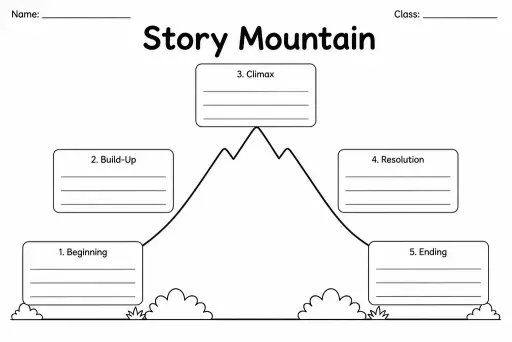
Story Mountain
Graphic Organizers
Ages 4–11
——
KiwiBee uses optional Google Analytics, Google Ads, and Meta Pixel cookies to understand adult visitors, measure completed sign-ups, and improve campaigns. Essential cookies always stay on. OpenAI’s ChatGPT Ads Pixel also measures page views and completed enquiries after advertising consent, and may use hashed contact details for matching. Privacy policy

A Word Web is a blank graphic organizer built around a central oval or circle where students write one key word, surrounded by radiating spokes that connect to empty bubbles for associations, definitions, synonyms, examples, or related concepts. It is one of the most versatile tools in any classroom from Grade 1 through Grade 6. Teachers reach for this template to introduce new vocabulary, activate prior knowledge before a read-aloud, or guide students through word study in any subject. Students use it independently during reading workshops or paired discussions to deepen word ownership. Because every spoke is blank, the same printable serves a first-grader naming picture words and a sixth-grader mapping academic vocabulary from a science unit.
Most versions include 6 to 8 spokes, which is enough to explore a word thoroughly without overwhelming younger students. You can fold or ignore extra spokes, or add more by drawing on the printed sheet.
Absolutely. Maths teachers use it to map properties of a shape, science teachers map parts of a system, and social studies teachers use it to explore a historical figure or event. The blank spokes work for any central concept.
Yes. Young students can draw pictures in the outer bubbles instead of writing words. The visual-spatial layout actually supports pre-writers in making conceptual connections before they can spell.
Laminating and using dry-erase markers is a great option for whole-class instruction or literacy centres. Alternatively, place it in a plastic sleeve for the same effect with no laminating machine needed.
See what other teachers think and share a helpful note.
Generate a fresh worksheet for any grade, topic and language. Free.
 Home
Home All solutions
 Pricing
 About us
 KiwiBee for Non-profits
 Events & webinars
 For big organisations
 For schools
 For centers
 For team leaders
 For teachers
 AI and resources
 Resources
 Printable worksheets
 Lesson Packs
 Interactive simulations
 Teacher tools
 AI studio
 Ideas and research