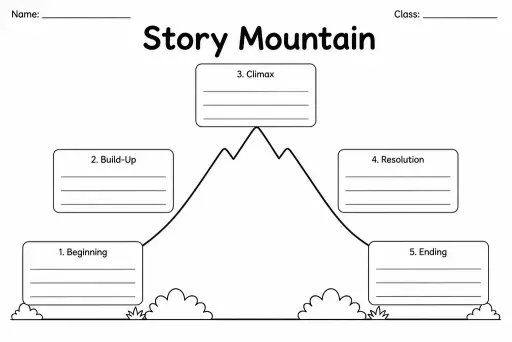
Story Mountain
Graphic Organizers
Ages 4–11
——
KiwiBee uses optional Google Analytics, Google Ads, and Meta Pixel cookies to understand adult visitors, measure completed sign-ups, and improve campaigns. Essential cookies always stay on. OpenAI’s ChatGPT Ads Pixel also measures page views and completed enquiries after advertising consent, and may use hashed contact details for matching. Privacy policy

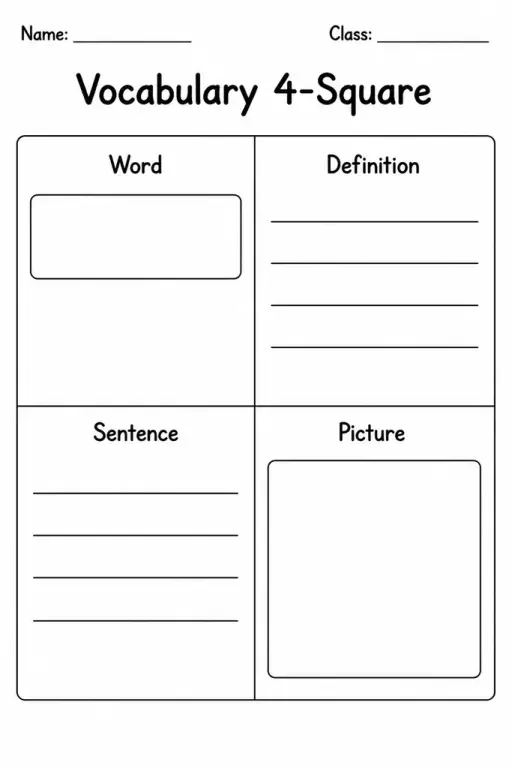
The Vocabulary Word Map is a structured graphic organiser with four clearly labelled boxes: the target word, its meaning in the student's own words, synonyms or related words, and an original sentence. Working through all four sections forces students to process new vocabulary at multiple cognitive levels — from recognition to production — which research consistently links to deeper retention than simple dictionary copying. Suitable for grades 2 through 8, the template is equally at home in an ELA lesson, a science unit introducing technical terms, or a social-studies class tackling disciplinary vocabulary. Because it ships blank, teachers can reproduce it for any word list without adapting content. Students build a personalised vocabulary bank over time; a stack of completed maps makes a useful revision resource before tests or essay writing.
Absolutely. It works well for science, history, maths, and any content area where students encounter unfamiliar technical vocabulary.
The Vocabulary Word Map focuses on meaning, synonyms, and original sentence use. The Frayer Model includes definition, characteristics, examples, and non-examples — a slightly different processing approach useful for concept-heavy vocabulary.
Encourage them to write related words, a word from the same family, or even an antonym. The goal is activating connections, not producing a perfect thesaurus entry.
The four-box layout is intentionally lean, but students can add a quick sketch in any available white space. Illustrations can reinforce memory for visual learners.
See what other teachers think and share a helpful note.
Generate a fresh worksheet for any grade, topic and language. Free.
 Home
Home All solutions
 Pricing
 About us
 KiwiBee for Non-profits
 Events & webinars
 For big organisations
 For schools
 For centers
 For team leaders
 For teachers
 AI and resources
 Resources
 Printable worksheets
 Lesson Packs
 Interactive simulations
 Teacher tools
 AI studio
 Ideas and research