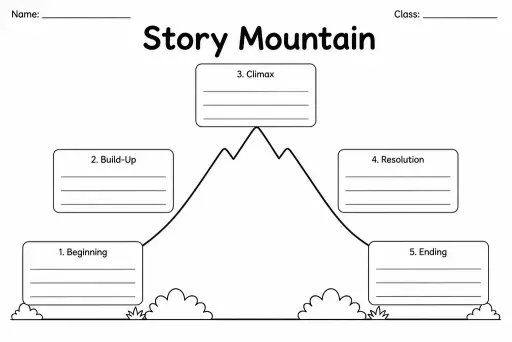
Story Mountain
Graphic Organizers
Ages 4–11
——
KiwiBee uses optional Google Analytics, Google Ads, and Meta Pixel cookies to understand adult visitors, measure completed sign-ups, and improve campaigns. Essential cookies always stay on. OpenAI’s ChatGPT Ads Pixel also measures page views and completed enquiries after advertising consent, and may use hashed contact details for matching. Privacy policy

The Vocabulary 4-Square is a single-word deep-dive organizer divided into four quadrants: the target word, its definition (in the student's own words), an original sentence using the word in context, and an illustration or symbol representing its meaning. Designed for grades 1–6, it is one of the most research-backed formats for building lasting vocabulary because it engages multiple processing modes simultaneously—linguistic, contextual, and visual. Teachers assign a square for every key term in a science, social studies, or reading unit; students use it independently during pre-teaching, during reading, or as a post-reading consolidation activity. The four-box layout is deliberately compact so students spend their effort thinking about the word rather than managing complex layout, and the picture quadrant makes the template accessible even for early readers or English language learners.
Their own words—always. Paraphrasing forces students to process the meaning actively rather than copy passively. Encourage them to check a dictionary first for accuracy, then restate it in language a classmate would understand.
Remind them that stick figures, diagrams, arrows, and symbols all count. The goal is a meaningful visual cue, not artistic quality. Some students prefer to cut and paste a tiny image from a magazine instead.
Research on vocabulary acquisition suggests four to six new words per instructional cycle for best retention. Assign the 4-Square to the highest-priority terms rather than every new word encountered.
Yes—maths terms like 'numerator,' 'perimeter,' or 'equation' work extremely well. The picture quadrant is especially powerful in maths because students can draw a labelled diagram rather than a literal image.
See what other teachers think and share a helpful note.
Generate a fresh worksheet for any grade, topic and language. Free.
 Home
Home All solutions
 Pricing
 About us
 KiwiBee for Non-profits
 Events & webinars
 For big organisations
 For schools
 For centers
 For team leaders
 For teachers
 AI and resources
 Resources
 Printable worksheets
 Lesson Packs
 Interactive simulations
 Teacher tools
 AI studio
 Ideas and research