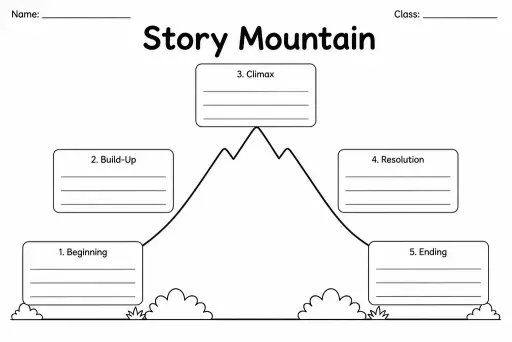
Story Mountain
Graphic Organizers
Ages 4–11
——
KiwiBee uses optional Google Analytics, Google Ads, and Meta Pixel cookies to understand adult visitors, measure completed sign-ups, and improve campaigns. Essential cookies always stay on. OpenAI’s ChatGPT Ads Pixel also measures page views and completed enquiries after advertising consent, and may use hashed contact details for matching. Privacy policy

A 3-circle Venn diagram arranges three large overlapping circles so that every possible intersection is visible: three outer regions for traits unique to each topic, three pairwise overlaps for traits shared by exactly two, and a center triangle where all three overlap. This makes it the go-to tool when a comparison involves more than two subjects and the relationships between them matter. Third through eighth graders use it to compare three characters in a novel, three branches of government, three animal species, three geometric figures, or three historical periods. Teachers use it as a culminating activity after reading multiple texts or conducting a research unit with three sources. Because filling in all seven regions requires careful analytical thinking, it works especially well as a guided whole-class activity before students attempt independent three-way comparisons in writing.
The 3-circle version has seven distinct regions instead of three, including three pairwise overlaps and a center shared by all three. This requires students to hold more comparisons in mind at once.
Third grade and up is the typical starting point. Younger students often find managing three topics at once overwhelming; the 2-circle version is better for grades 1-2.
Model the process with a familiar example first (compare three foods: apple, orange, banana). Ask 'does this belong to ALL three, or just two?' before placing each item.
Yes — assign one circle per group member during brainstorm, then collaborate on filling the overlaps. Each person becomes the expert on their topic first.
See what other teachers think and share a helpful note.
Generate a fresh worksheet for any grade, topic and language. Free.
 Home
Home All solutions
 Pricing
 About us
 KiwiBee for Non-profits
 Events & webinars
 For big organisations
 For schools
 For centers
 For team leaders
 For teachers
 AI and resources
 Resources
 Printable worksheets
 Lesson Packs
 Interactive simulations
 Teacher tools
 AI studio
 Ideas and research