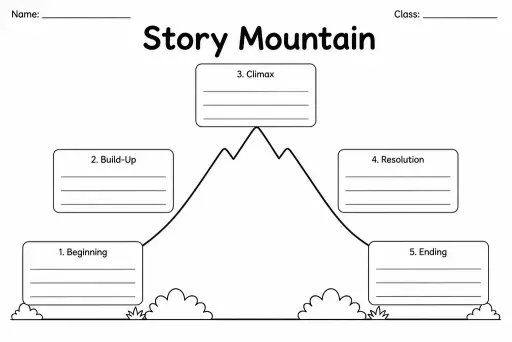
Story Mountain
Graphic Organizers
Ages 4–11
——
KiwiBee uses optional Google Analytics, Google Ads, and Meta Pixel cookies to understand adult visitors, measure completed sign-ups, and improve campaigns. Essential cookies always stay on. OpenAI’s ChatGPT Ads Pixel also measures page views and completed enquiries after advertising consent, and may use hashed contact details for matching. Privacy policy

The Variety Comic Layout template breaks away from uniform grids by presenting a mix of panel shapes and sizes on a single page — some wide and cinematic, some tall and narrow, some compact squares — mirroring the dynamic composition found in published graphic novels. This variety lets students naturally learn that panel size signals importance: a large panel for a dramatic reveal, a slim sliver for a fast action beat. Designed for grades 2 through 8, it challenges students to think about visual pacing and page design rather than just filling identical boxes. Art teachers use it to introduce layout principles; English teachers use it for creative retelling; gifted students appreciate the design freedom. The blank panels arrive with subtle borders but no pre-set content, so every layout decision belongs to the student.
The mixed panel sizes push students to make intentional composition decisions, which builds both artistic thinking and narrative awareness. It mirrors professional graphic novel design more closely than equal grids.
It starts at grade 2 because the irregular shapes can feel less guided. For grades 2–3, pre-assign which scene goes where to reduce overwhelm; older students can make those decisions independently.
Yes. The wide panels work well for labelled diagrams or maps, while narrow panels can show sequential steps, making it a flexible infographic organiser too.
The printed borders are fixed guides. Students are encouraged to extend or overlap artwork across borders intentionally to create bleed effects — a technique often discussed in art class.
See what other teachers think and share a helpful note.
Generate a fresh worksheet for any grade, topic and language. Free.
 Home
Home All solutions
 Pricing
 About us
 KiwiBee for Non-profits
 Events & webinars
 For big organisations
 For schools
 For centers
 For team leaders
 For teachers
 AI and resources
 Resources
 Printable worksheets
 Lesson Packs
 Interactive simulations
 Teacher tools
 AI studio
 Ideas and research