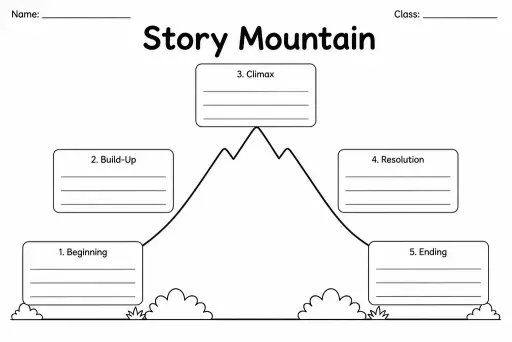
Story Mountain
Graphic Organizers
Ages 4–11
——
KiwiBee uses optional Google Analytics, Google Ads, and Meta Pixel cookies to understand adult visitors, measure completed sign-ups, and improve campaigns. Essential cookies always stay on. OpenAI’s ChatGPT Ads Pixel also measures page views and completed enquiries after advertising consent, and may use hashed contact details for matching. Privacy policy

The Blank Timeline template features an empty horizontal track with evenly spaced event tags hanging above and below the line, ready for students to fill in dates, labels, and brief notes. Grades 2–8 use it across history, science, biography, and literature units to show how events or developments unfold over time. Teachers project a completed model on the board, then hand out blank copies for students to build their own timelines from text or research. It is equally useful for a parent helping a child map out a biography project or visualize the life cycle of a topic for a science fair board. The fully blank design means the timeline spans any period—a single day, a decade, or centuries—making it versatile for a first-grade author biography and a middle-school unit on ancient civilizations alike. Students develop a concrete visual sense of chronology every time they complete it.
The template includes enough tags for 6–8 events, which is appropriate for most elementary and middle school projects. For denser timelines, students can space events more closely or continue on a second sheet taped to the first.
Yes. It works well for mapping the plot events of a novel in the order they occur, or for comparing a story's timeline with real historical events that form its backdrop.
Dates are optional. For relative timelines—stages of a life cycle, chapters of a book—students simply write ordered labels or brief descriptions without specific dates.
Absolutely. Print one copy per group. Students divide the research, each filling in a section of events, then combine their findings onto a single completed timeline.
See what other teachers think and share a helpful note.
Generate a fresh worksheet for any grade, topic and language. Free.
 Home
Home All solutions
 Pricing
 About us
 KiwiBee for Non-profits
 Events & webinars
 For big organisations
 For schools
 For centers
 For team leaders
 For teachers
 AI and resources
 Resources
 Printable worksheets
 Lesson Packs
 Interactive simulations
 Teacher tools
 AI studio
 Ideas and research