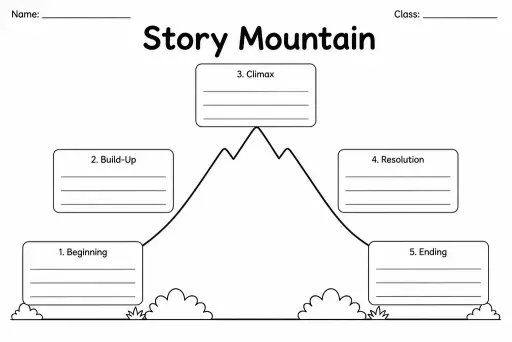
Story Mountain
Graphic Organizers
Ages 4–11
——
KiwiBee uses optional Google Analytics, Google Ads, and Meta Pixel cookies to understand adult visitors, measure completed sign-ups, and improve campaigns. Essential cookies always stay on. OpenAI’s ChatGPT Ads Pixel also measures page views and completed enquiries after advertising consent, and may use hashed contact details for matching. Privacy policy

A T-chart is a two-column graphic organizer shaped like the letter T: a horizontal line across the top with a vertical line dividing the page beneath it. Each column carries its own header, and students list items, facts, or ideas under whichever heading they belong to. It is one of the fastest and most flexible thinking tools in any classroom because it requires almost no explanation — the layout makes the task immediately obvious. Kindergarteners through eighth graders use it across every subject and grade level. Teachers reach for it when sorting pros and cons, causes and effects, fiction and nonfiction features, primary and secondary sources, or before-and-after observations. Parents use it at home for decision-making conversations or reading-response activities. Because the two columns are completely blank, the same printable works for a five-year-old listing big/small animals and an eighth grader analyzing narrative technique.
A T-chart separates two categories with no overlap region, making it better for strict either/or sorting. A Venn diagram adds a center overlap for shared traits — use a Venn when similarities matter as much as differences.
Yes. Kindergarteners can draw pictures instead of writing words in each column, making it accessible even before full literacy. Pair with a teacher-read-aloud and sort together as a class.
There is no required number — the chart scales with the task. Primary students might list 3-5 items per column; middle-school students might fill 10-15 rows per side.
A T-chart is specifically two columns. For three or more categories, use a multi-column comparison chart. The simplicity of two columns is what makes the T-chart so quick to use.
See what other teachers think and share a helpful note.
Generate a fresh worksheet for any grade, topic and language. Free.
 Home
Home All solutions
 Pricing
 About us
 KiwiBee for Non-profits
 Events & webinars
 For big organisations
 For schools
 For centers
 For team leaders
 For teachers
 AI and resources
 Resources
 Printable worksheets
 Lesson Packs
 Interactive simulations
 Teacher tools
 AI studio
 Ideas and research