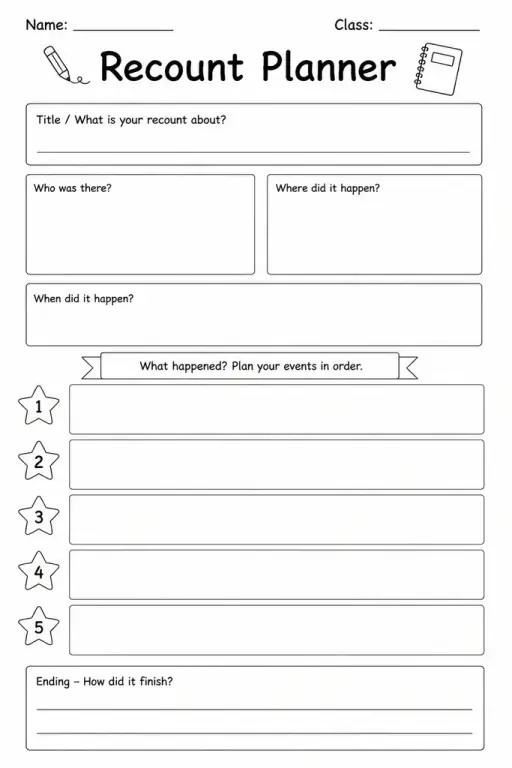
Recount Planner
Graphic Organizers
Ages 4–11
——
KiwiBee uses optional Google Analytics, Google Ads, and Meta Pixel cookies to understand adult visitors, measure completed sign-ups, and improve campaigns. Essential cookies always stay on. OpenAI’s ChatGPT Ads Pixel also measures page views and completed enquiries after advertising consent, and may use hashed contact details for matching. Privacy policy

The story mountain is a visual narrative-planning template shaped like a hill or mountain outline divided into five labeled points: Introduction, Build-Up, Problem (or Climax), Resolution, and Ending. Each stage sits at a distinct point along the mountain's slope, making story structure intuitive and concrete for young writers in grades 1–6. Unlike the more formal plot diagram used in upper elementary analysis, the story mountain uses everyday language that resonates with primary and lower-intermediate students before they encounter literary terminology. Teachers use it as a planning scaffold before a writing assignment and as a retelling tool after shared reading. Students can sketch scenes in each section or write brief notes — making the template flexible enough for illustrated books, simple chapter outlines, and personal narrative drafts.
The story mountain uses child-friendly labels (Introduction, Build-Up, Problem, Resolution, Ending) suited to grades 1–6. The plot diagram uses formal literary terms (Exposition, Rising Action, Climax, Falling Action, Resolution) and is aimed at grades 4–8 for literary analysis.
With teacher modeling, grade 1 students can draw pictures in each section rather than write sentences. Writing short phrases becomes accessible by mid-grade 1 for most students; full sentences suit grades 2 and up.
For young writers, 2–3 events is ideal — enough to create tension without overwhelming the page. Older students in grades 5–6 can note more detail, but the template's value is in capturing key beats, not every scene.
It is designed for narrative fiction and personal narrative. For non-fiction reports or explanatory writing, a different organizer (e.g., a mind map or outline) is more appropriate.
See what other teachers think and share a helpful note.
Generate a fresh worksheet for any grade, topic and language. Free.
 Home
Home All solutions
 Pricing
 About us
 KiwiBee for Non-profits
 Events & webinars
 For big organisations
 For schools
 For centers
 For team leaders
 For teachers
 AI and resources
 Resources
 Printable worksheets
 Lesson Packs
 Interactive simulations
 Teacher tools
 AI studio
 Ideas and research