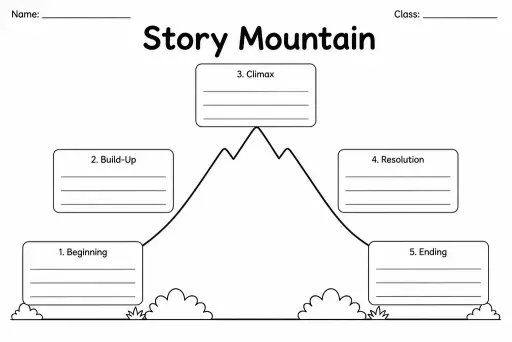
Story Mountain
Graphic Organizers
Ages 4–11
——
KiwiBee uses optional Google Analytics, Google Ads, and Meta Pixel cookies to understand adult visitors, measure completed sign-ups, and improve campaigns. Essential cookies always stay on. OpenAI’s ChatGPT Ads Pixel also measures page views and completed enquiries after advertising consent, and may use hashed contact details for matching. Privacy policy

A story elements template breaks a narrative down into its four essential building blocks—characters, setting, problem, and solution—each inside its own clearly labeled box. Students in grades 1–5 use it to record what they noticed while reading, organizing their thinking before writing a response or joining a discussion. Because the template is blank and generic, it works for picture books, chapter books, folk tales, myths, or any short story. Teachers value the visual separation of each element: it makes the abstract structure of stories concrete and tangible for young readers. The template is equally useful as a pre-writing planner for students crafting their own original stories. Print one per read-aloud, one per independent book, or one as a class anchor chart that the teacher fills in together with students during shared reading.
Students should identify the most important central problem and the two or three characters most essential to the story. The template focuses on the big picture, not every detail.
Yes—this is one of its best uses. Students fill in the four boxes with their own planned characters, setting, problem, and solution before drafting, which leads to more structured narratives.
With adult support, yes. A teacher or aide can scribe while the student dictates, or students can draw pictures inside each box to represent the element rather than writing words.
This template focuses exclusively on the four structural elements of a story—characters, setting, problem, solution—without opinion or summary fields. It is more analytical and works as both a reading response and a writing planning tool.
See what other teachers think and share a helpful note.
Generate a fresh worksheet for any grade, topic and language. Free.
 Home
Home All solutions
 Pricing
 About us
 KiwiBee for Non-profits
 Events & webinars
 For big organisations
 For schools
 For centers
 For team leaders
 For teachers
 AI and resources
 Resources
 Printable worksheets
 Lesson Packs
 Interactive simulations
 Teacher tools
 AI studio
 Ideas and research