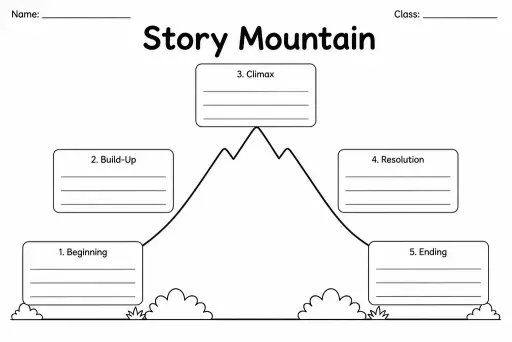
Story Mountain
Graphic Organizers
Ages 4–11
——
KiwiBee uses optional Google Analytics, Google Ads, and Meta Pixel cookies to understand adult visitors, measure completed sign-ups, and improve campaigns. Essential cookies always stay on. OpenAI’s ChatGPT Ads Pixel also measures page views and completed enquiries after advertising consent, and may use hashed contact details for matching. Privacy policy

The Stars and Wishes 4-Quadrant template divides a page into four equal boxes: Stars (what went well), Wishes (what could be better), What I Learned, and What I Want to Try Next. The structure gives students in Grades 3–8 a gentle, approachable framework for self-reflection and peer feedback — close in spirit to a SWOT analysis but in language that feels natural and non-threatening to children. Teachers use it after projects, presentations, sports days, science experiments, or writing drafts to help students move beyond a simple 'it was fine' response into genuine metacognitive reflection. Parents find it equally useful at home after a test, a recital, or any activity where a child needs to acknowledge effort and set a concrete next step. The four-quadrant layout keeps responses balanced, ensuring students recognise strengths before listing areas for growth.
It shares the four-quadrant format but uses child-friendly language. Stars and Wishes replace Strengths and Weaknesses, avoiding deficit-focused vocabulary, while the Learned and Try Next quadrants add a forward-looking, growth-oriented dimension not present in a standard SWOT.
Yes. Students can complete the template about a partner's presentation or piece of work. The positive framing of Stars and Wishes makes peer feedback feel supportive rather than critical.
Roughly two to three minutes per quadrant is typical for a focused reflection session — about ten minutes total. Longer is fine for older students working on complex projects.
It is effective from Grade 3 upward. For Grade 3–4 students, teachers sometimes provide sentence starters (e.g. 'I did well at…', 'Next time I want to…'). Upper-primary and middle-school students can write freely without prompts.
See what other teachers think and share a helpful note.
Generate a fresh worksheet for any grade, topic and language. Free.
 Home
Home All solutions
 Pricing
 About us
 KiwiBee for Non-profits
 Events & webinars
 For big organisations
 For schools
 For centers
 For team leaders
 For teachers
 AI and resources
 Resources
 Printable worksheets
 Lesson Packs
 Interactive simulations
 Teacher tools
 AI studio
 Ideas and research